
In a company with several inspectors on the road, a surprising amount of the workload has nothing to do with inspecting.
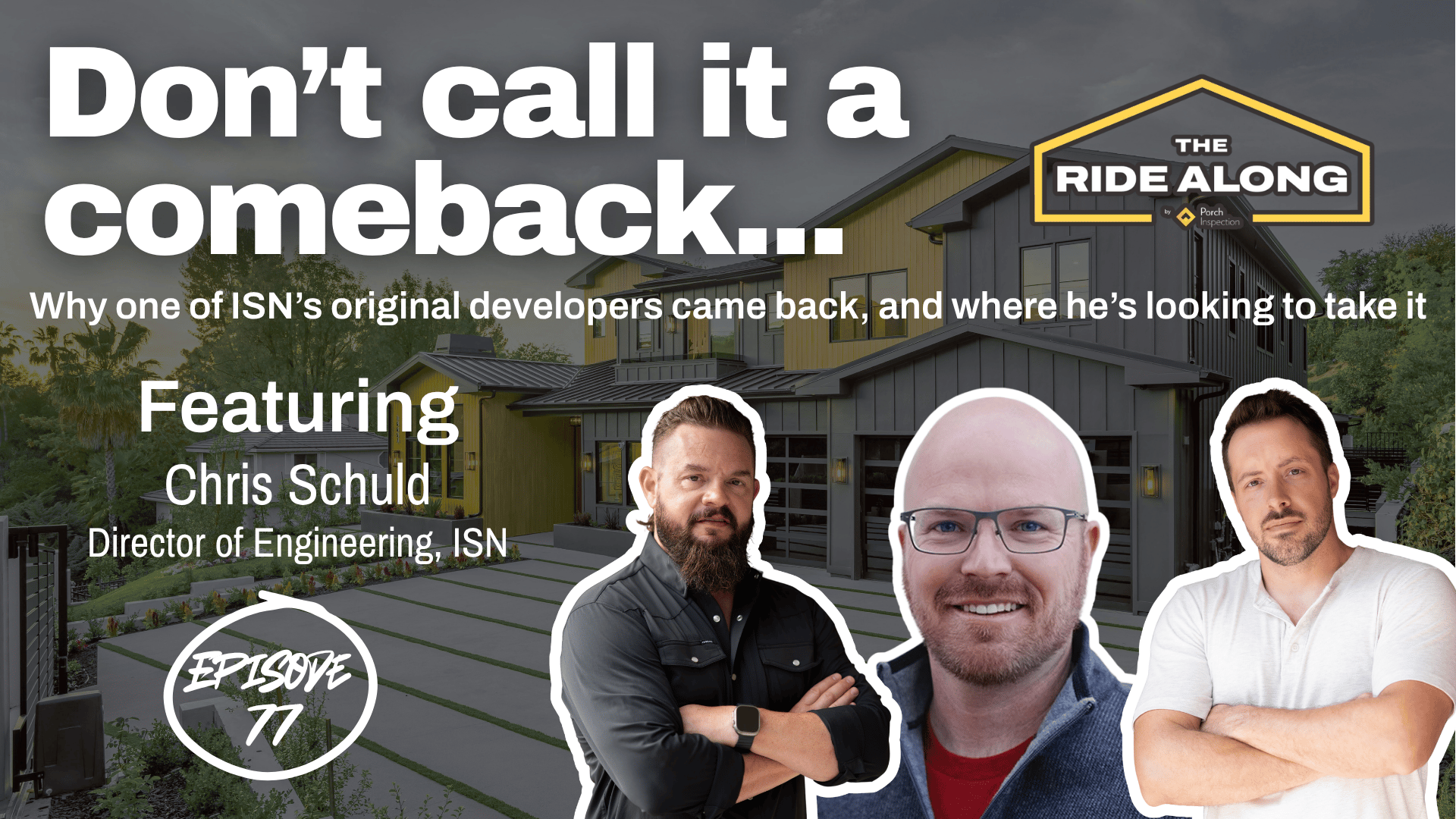
In episode 77 of The Ride Along, recorded live at Inspection Fuel V in Louisville, Brad Lowery and Matt Brading sat down with Chris Schuld, Director of Engineering, Inspection, to talk about where the software is headed and how AI fits into the daily work of a growing inspection business.
Chris is focused on the busy work first: data management tasks like getting a business card into ISN, and letting AI work with all of the data you already have in ISN to deliver business intelligence. For a multi-inspector company, that is where hours quietly disappear across owners, office staff, and schedulers.
He is also clear about what automation is not meant to do. The goal is not to remove the human from the process. It is to automate the work around the human so your team is set up for success when they are in front of a client. Chris has a second AI focus on the engineering side as well: helping his teams build faster and communicate with customers more effectively.
The conversation also covers how ISN got here. Chris started out writing software to replace three-part carbon forms for an early home inspection business, then shifted from solving the inspector’s problems to solving the problems of running the business. His team used to carry a yellow pad to trade shows and write down every time they had to tell an inspector no, then took that list back to engineering. He still spends time talking with inspectors face to face at shows for the same reason.
For inspection company owners, his long-term vision is simple: if you are chained to your business, what if you could chain the AI to the business instead?
Want conversations like this delivered straight to your inbox? Subscribe to The Ride Along newsletter and never miss a new episode.

Transcript
Brad Lowery
Guys, welcome back into the ride-along. We are live from
Matt Brading
Kentucky
Brad Lowery
at inspection fuel. Yep. This is this is awesome. Yeah,
Matt Brading
Should have thrown that in there.
Brad Lowery
probably ships. It’s okay. It’s a little bit backwards, kinda like this video. This is actually the second time we’ve shot this. I had to think
Matt Brading
Think about where we were. You didn’t say you were gonna do that.
Brad Lowery
you know what the cool thing is about doing this online? Is that I can keep my laptop plugged in and things don’t die. But we had we had a little mishap with the camera.
Matt Brading
We’ve had plenty of audio and technical difficulties whenever we did this from the comfort zone.
Brad Lowery
our own help. Well I mean is there’s that, but also, you know, we’re MCing this thing and I feel like the entire thing has been a crash course in we’re master ad libers. Like we’re we’re good at improv, Matt.
Matt Brading
We are? I mean I like to think so. Yeah. I’ll pat myself on the back. I’ll tell you you’re good. You tell me I’m good.
Brad Lowery
I heard that if you’re really good at improv, it’s a sign of true genius is what it is. So I’ve never heard that. I only I just heard it now in my head. I did. That’s that’s exactly what it was. But guys, we have an actual genius that’s here as the new head of engineering, director of engineering. It’s director. Yeah.
Matt Brading
No pressure or anything. Yeah, no pressure.
Brad Lowery
Right. We have a genius here as the director of engineering, Mr. Chris Schuld. Dude, welcome back to Inspection Support Network Man. This is a return because you’ve been here before and now you’re back again. It is.
Chris Schuld
return. Thanks for having me guys. I appreciate it.
Matt Brading
And it’s also a return ’cause we just did this a few minutes ago and now we’re doing it again. It’s back
Chris Schuld
We get to do it the second time. Yeah. Yeah.
Matt Brading
Thanks.
Brad Lowery
He’s so thrilled that he’s here again. We just had so much fun with you the first time because we were like we’ve only got to know this guy for a few minutes.
Matt Brading
honestly there’s no technical difficulties at all. We just wanted
Brad Lowery
We just wanna hang out with you so you’re
Chris Schuld
Awesome. Yeah guys.
Brad Lowery
welcome. Yeah. Okay.
Matt Brading
back Chris.
Chris Schuld
Thank you.
Brad Lowery
Actually, all right, for those that don’t know ya, let’s tell them a little bit about your backstory, how you got involved with inspection support network. because it’s pretty cool. Like and I said this because for those for folks that meet you, you are so straightforward and to the point, in the best way. It’s not like he’s a jerk about it or anything. He’s just like he’s you know e exactly who he is and what he’s about. It’s like a home inspector almost. So I mean, for somebody that Does engineering for home inspectors, working with home inspectors. There’s a story here. So so fill everybody in.
Chris Schuld
Yeah, yeah. So I was a a builder’s kid. My dad was an entrepreneur, built homes, built custom homes, and he had a cabinet shop and he did trim carpentry. So my summers growing up were was doing trades. So I would be framing in the summer or doing trim for him. So like housing was very normal to me as far as residential real estate. And then when I was junior in high school, my dad told me, he’s like, Kid, you were not allowed to swing a hammer. And because he he was like, You need to go chase these computer things that you’re very passionate about. And at the time I w my long end goal was to go do chip design for Intel. So I got to do that, went to Arizona State University, graduated from there, went to work for Intel, got to design a couple chips, it was really cool stuff. While I was there, I was moonlighting writing software for at the time my uncle’s home inspection business. And he ended up being the other partner of mine in ISN, Dan Huber. And so he was building a home inspection business, and at the time it was three-part carbon farm. three part carbon forms, so OG home inspection stuff like right in the very beginning, right? So we were trying to use software to replace that process of of handwriting. And and that’s kind of the backstory of it. And we built a report writer and then we eventually kind of went after the management of it and the calendaring and the scheduling because we sort of solved the pain of the inspector and we switched gears and tried to solve the pain of running the business. And so that’s kind of the backstory of where ISN came from. It was growing that software to solve his own business challenge, and then it just balloons from there.
Matt Brading
Well that’s great. So I this is like off topic a little bit. And like if you’ve watched the show ever, then you know I’m probably pretty much the king of off topic. But anyway, kudos to your dad. Because like there’s a lot of professions where like A father might be like, Yeah, don’t do what I do. Okay. Don’t follow my path. But someone in construction, I feel like it’s almost mandatory. Like, you gotta do this. This is the business. This is what you gotta do. But your dad said, No, actually I can see you’re on something else. Take that path. That’s pretty cool.
Chris Schuld
Kudos for him for sure. Yeah, absolutely.
Brad Lowery
Now and I can’t even imagine that you guys were discussing issues around automation and stuff for inspectors back then. I guess that’s it was such a very different world at the time. And this the ta the problems you’re tackling now, it’s a it’s light years beyond where things were.
Chris Schuld
Yeah, the problem surface was so different then than it is now. I mean, back this is back when the internet was super scary, relative to like dial up connections and i are you gonna be online? That was the most common thing we got in our early conferences.
Brad Lowery
That’s scary though, ’cause like I was mostly scared of like, did the girl I had a crush on see my away message or something?
Matt Brading
I mean when it comes to business it was scary. I mean like there is Y two K stuff and all it people were literally scared of this stuff.
Chris Schuld
Yeah, that that’s the exact time frame when it started too. It was around that time frame when you know, there people were worried about like what if I store my stuff online and and that was all new. And now the problems are completely different. You know, now you have issues of scale and speed and bandwidth and AI and just there’s so many different pieces of of concern.
Matt Brading
Nobody would ever think to store so much paper as we did back then. I know. I mean there were file cabinets, there were rooms that businesses dedicated to the storage. Yeah. Now it’s a completely different landscape.
Chris Schuld
Yep. Yeah, it’s crazy. We had an inspector early on that scanned all their report their older reports and uploaded them into their ISN. And then months later, their storage unit with all their banker boxes, with all the three part carbon forms, it burned to the ground. And they had to you they they state regulations, they had to keep them for so many years, they had it all stored on ISN and it was sort of like almost a commercial for us of like that that shift of mindset of moving to the internet to store things.
Brad Lowery
That’s wild. Now was that like early days of cloud storage back then?
Chris Schuld
Yeah, well there was no cloud s like there was cloud storage, but we were the cloud storage. So early on we self hosted. We were in our own data center, we had our own servers. And then as Amazon AWS grew, we sort of moved into them at that time. But yeah, it was ear this was early, like OG web like web app building.
Brad Lowery
Now, it’s interesting you mentioned AWS because you had a little bit of an experience with them or with a competitor, right? After leaving ISN. So tell us about a little bit about that journey, the time between the ISN times.
Chris Schuld
Yeah, I did. I did a couple of little startups after I left that were kind of they were kind of in taking over the challenges we had at ISN and kind of building them into their own SaaS applications. And they were starting to work really well. And then AWS came and they made that same feature. And of course you you can’t compete with them, so I would those sort of had their own trstruggles as Amazon sort of took over that business. So yeah, and then I ended up having a a good friend of mine sold his business to Wix. and called me and begged me to come help with them and so I ended up managing engineering teams at Wix, which was really cool ’cause that that scale is massive. Like Yes.
Matt Brading
Yeah.
Chris Schuld
It was it was that there were just different engineering challenges that were really fun. It was no big deal to have a a million people use a new feature in inside of twenty four hours. So it was pretty cool.
Brad Lowery
Well one of the things that you told me before that you guys really focused on was like listening to inspectors issues and and tackling and solving for those with the early iterations of ISN, but that’s still something that you’re doing today. And especially at a at a conference like this, it it facilitates and gives opportunity to some conversations where you can get those issues firsthand and you can hear what they’re struggling with firsthand. So what are some of the things that you talk to inspectors about here at Field?
Chris Schuld
Yeah, so we it’s always been a passion for us. We I’ll come around to that exact question, but it’s always been a passion for us of like solve the the inspectors’ offices and business problems. And so we used to actually have a yellow pad that we would take with us to the shows and we would write down every time single time we had to say no. And then we would take the yellow pad back in an engineering level and just solve for all those problems so that next time we wouldn’t have to say no. And I take that same passion even now and I talk to the inspectors and people that are running their their offices. And it’s to me it’s important to hear like what are your challenges? Where is ISN causing you trouble? Like how can we improve it? And so thosethose schemes are really important to me and that’s why I spend so much time interacting with the inspectors, especially at the shows, ’cause I can get I can spend time with them face to face.
Matt Brading
Well that’s what’s so cool about these shows, right? Because like without the show, ISN’s just software, right? But it but you get to meet some of the people behind the software and actually develop a relationship. They can actually talk to you in person about their pain points and and you can work towards a solution for that kind of stuff. And they get to know you on a more personal level instead of just being something that they may or may not be frustrated with or maybe maybe they maybe they love it. Either way. Before that that’s just a computer screen to them, but they actually get to come out here to these shows, meet other inspectors and actually meet the people behind the software that we use.
Chris Schuld
Yeah, the people that are involved are is such an important part of it. I mean, Adam Long called me and said, Would you know, would you ever entertain coming back? And that’s you know, it was an important step because it to me was the people that were on the team. And I even got a chance to bring back one of my best engineers that I wrote most of ISN with, Steve Massey. He’s he’s come back with me. And so it’s really cool to kind of come back to these like great people to work with and then d then come to these shows and see all the people that I knew thatare still in the industry. It’s such a cool thing ’cause the people are really the driving fi the thing.
Brad Lowery
No, no, definitely, man. So with that in mind, what are some of the initiatives that you’re really kind of looking forward to and trying to implement coming up here with with ISN?
Chris Schuld
Yeah, so l everyone’s talking about AI right now. AI’s the hot thing. and I AI’s interesting. It’s it’s really changing the landscape for software development the most. and so the discipline of software engineering has changed a bunch. it’s the only engineering discipline where you don’t have a builder. So like a civil engineer, they do work on the plans, they get all the calculations correct, they stamp it, and then they send it to a team that does the welding and the steel and the assembly and all of that. Whereas in software, we didn’t have those builders before. But now, as a software engineer, you can do the design. You can hand the design off to a bunch of basically robots and let them do the building and construction for you. And so the automation intensity you get from that is really really amazing. And so I just want to take some of that automation and kind of leverage it for the inspectors, mainly to save them time through just like natural automation to give them time back.
Brad Lowery
Now that’s that’s massive, man. And honestly, this isn’t just something that that you’re looking to do here at ISN. This is something that like Apple was just in the news. their CEO is really trying to streamline and reorganize their engineering department so that they could speed things up. So it’s not things aren’t laboring in development for too long or rolling out too slowly to keep up with the market. they’re really trying to to lead the way on things so that they can adapt quickly in the AI era. Yeah. So that that’s cool. It’s we’re doing something it sounds like something similar here. But what’s awesome and Matt, you know, we talked about this on the show with Bo Brown, who’s who is a presenter here as well at Fuel. And you know, when it comes to AI, there’s there’s two camps. There’s you know, eagerness and there’s there’s fear about whether or not somebody’s gonna have their job replaced by AI or something like that. But What’s cool with it with what you’re everything you’re saying is it showcases that AI is not replacing, it’s augmented. Right? It they the people behind it are still the ones that have to use the tool to bring the improvement for the people that are using the tool on the user’s end.
Chris Schuld
Yeah. I think a large portion of of actual property inspection i is the relationship and the human and the interaction and the management of everything. And it’s a very human-esque thing. The the the pieces of the property inspection that are not human driven, I think are the parts that we can help automate and speed up. And then if we the in the perfect world, if we could give all that time back to just being the human side of it and the relationship side of it and and helping someone who’s buying their first home who’s scared, like all of those those pieces of the human r element. If we can if we can give you more time to to have that part and we use AI and our tools and the software and to kind of help with the other parts of the busy work, if you will, that would be a home run.
Matt Brading
The human part is just it it has to be there. It’s it’s it’s absolutely mandatory. I mean a lot of it comes down to the delivery of information, right? Like, so what can a AI do? It eventually maybe it can look at a picture and accurately determine what’s going on. But that doesn’t mean it can deliver that information in a way that you can under that you can understand. the AI’s not gonna be able to read the room and say, Okay, well this is the kind of person I’m dealing with and so let me adapt how I tell this information. It’s gonna be very direct. Right. There’s always gonna take a human being with their brain, with their eyes, with what they’ve seen before, and their ability to have relationships with people in the room and to deliver that information. AI is a tool and it can be used as a tool and it’s very helpful. And I have used it a lot. and to think that you’re taking AI and integrating it into parts of ISN to help us get back our time and and do things more efficiently, that’s incredible. I’m I’m really looking forward to that.
Chris Schuld
Yeah, I mean you you’re seeing it used really well like in radiology as an anecdote. You know, you if you have a an AI reading a an X ray or and it’s finding these very key things, it’s still getting past a radiologist saying, Well, that yep, it found this and this and this and my gosh, I didn’t see this initially. Th these are great things. If we can give that level of clarity to the inspectors and still let them make those final decisions, it’s amazing.
Brad Lowery
Yeah, that’s awesome. But the time saving is what’s huge too. Because the the biggest issue, and and Mark Humold, the keynote speaker here, he was just talking about this, how people end up kind of being chained to the business and not the other way around. The business isn’t providing for their quality of life that they envisioned. It’s you serve the business. And the time savings here is gonna allow them to get back to being, you know, husbands, fathers, just enjoying hobbies and stuff and not just constantly working sun up to well past sun down.
Chris Schuld
Yeah, I mean if you’re if you’re basically chained your business, the beauty of the AI is what if we could chain the AI to the business? Yeah. Right. And so that’s that’s kind of like my longer term vision of it is to to augment the business so that the human side can go do human things.
Brad Lowery
That’s awesome, man. So with that in mind, thinking long term, what are some of the cool stuff that inspectors can look forward to here in the next year or two?
Chris Schuld
Yeah, I think looking forward, we want to take a lot of the the pains of data management, of of taking a a a business card and getting that into your ISN or or having AIs be able to easily interact with all of your data inside of ISN to do business intelligence and and sort of use it to take that busy work away. That’s kind of my focus initially with the AI pieces. The AI pieces also has a completely other tangent, if you will, of me like doing the engineering side of it. How do I have our teams go faster? How do I help customers more effectively? How do I communicate with customers more effectively? Those can all be not automated where the human is missing, but automated to tee up the h the human for success.
Brad Lowery
Yeah. No, that’s awesome, man. And honestly, just another reason that everybody else should be excited that you’re back. It’s this is great. You know, the drink of the day is real easy. We gottaget there. We have to have it.
Matt Brading
We’re getting there pretty quick because I’ve been working on mine. Yeah. So
Chris Schuld
Second time.
Matt Brading
yeah, well, I mean your yours has, but you know. But but you’re talk doing most of the talking here, and I’m doing most of the drinking. Anyway, welcome back. And the drink of the day today, we’re all having old fashioned this is a very you know, we’re we’re in Kentucky. You know, went in Rome. That’s it. Do do do as Romans do, as they say. So cheers.
Brad Lowery
Cheers everybody. Salute. Welcome back, Chris. That’s awesome. Thank you. I appreciate it. And cheers to y’all. Make sure that you keep an eye out for the next inspection fuel. Be sure to register to the Rod or subscribe to the Rod Along here. Or register for the inspection fuel newsletter. Because we’re going to have another one at some point. It’s in the works. But you don’twant to miss out. I mean, this has been a fun conference, dude.
Matt Brading
It’s been great conference. I’ve really enjoyed it.
Brad Lowery
Yeah, definitely, for sure. So Chris, thank you so much for the time. Thank you everybody for watching. And we’ll see ya here, well not here, but proverbially on the channel next time, right on.
Matt Brading
They’re right along.
Brad Lowery
Dude.
Chris Schuld
But I turned off a couple minutes ago.
Matt Brading
Yeah. I was about to
Brad Lowery
So much.
Matt Brading
say gotta hope that’s reported. Hey You killed him.
Brad Lowery
Okay.