
Reinspections get a lot more complicated the moment you’re not the only one doing them.
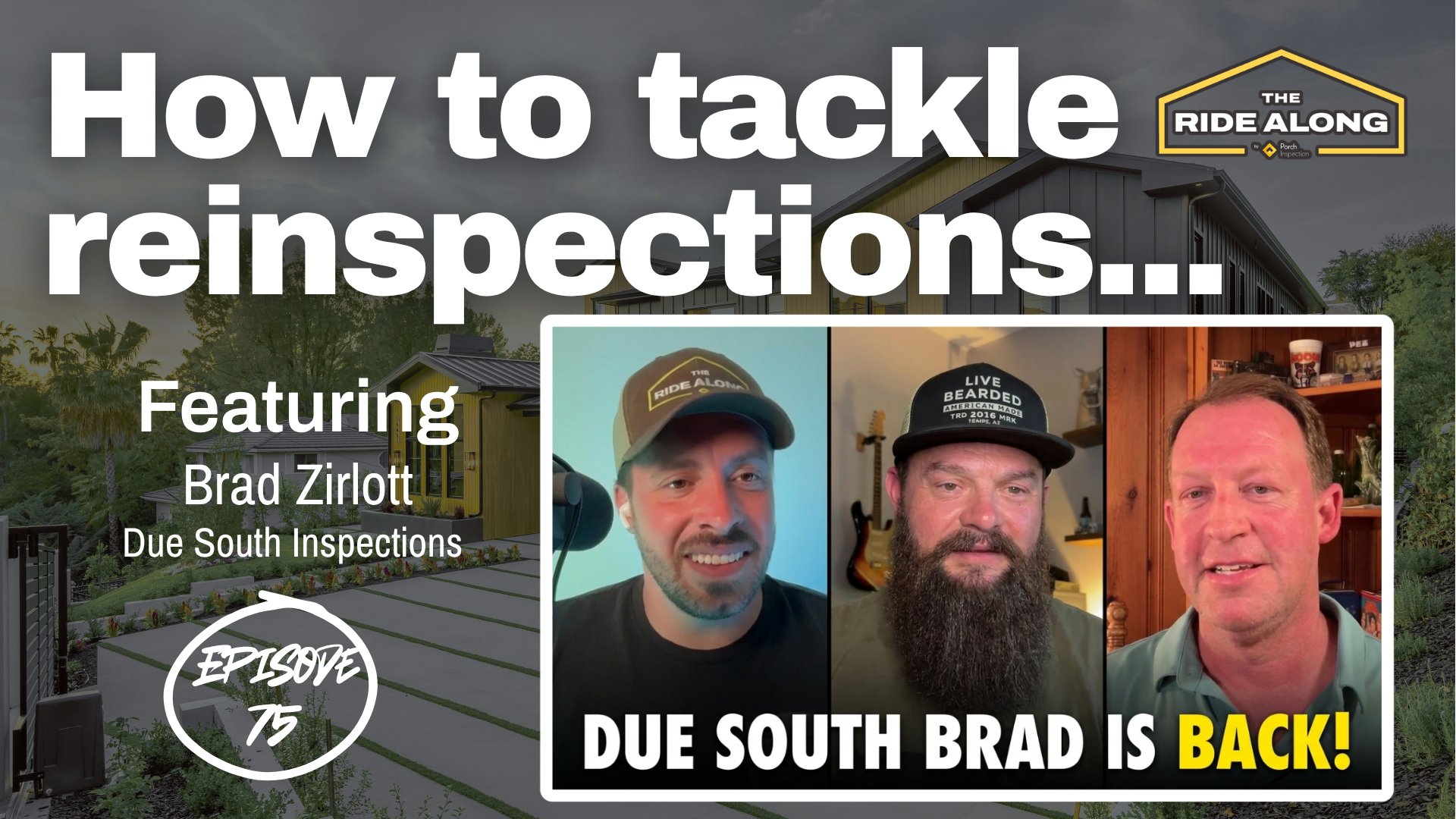
That’s the thread Brad Lowery and Matt Brading pull on in The Ride Along episode 75 with returning guest Brad Zirlott of Due South Home Inspections.
What starts as a shared complaint about botched seller repairs turns into a real conversation about the economics of reinspections once a team is involved — and why a policy that works fine for a solo inspector can quietly wreck morale across a company.
Matt talks through a problem a lot of growing companies eventually hit: when inspectors are working on a commission split, a discounted reinspection fee can leave them making almost nothing for the same drive time and effort as a full inspection. His fix was to raise the split specifically on reinspections, or take them on himself when his schedule allows, so the company absorbs the overhead instead of the inspector eating the loss. Brad Zirlott, who has run both as a solo operator and with a team, agrees it’s a tightrope — give an inspector too many discounted reinspections and “that percentage better be considerable, because now they’re taking home less.”
It’s a practical, occasionally hilarious conversation (the flex-tape-covered outlet story alone is worth the watch) about a topic Brad Zirlott says the industry doesn’t talk about enough: how much reinspections actually cost a growing company in time, morale, and margin — and what to do about it.
Want conversations like this delivered straight to your inbox? Subscribe to The Ride Along newsletter and never miss a new episode.

Transcript
Brad Lowery
Matt, I’ve got a big problem I want to talk about with you.
Matt Brading
This sounds heavy. Go ahead.
Brad Lowery
I dude, reinspections, man. I I mean, we complain about this on the phone, but they drive me up the wall. Right. How do you feel about them?
Matt Brading
Yeah. Yeah. And it it’s I mean, I think that number one, I think that this is a topic that is not talked about enough in our industry. I definitely have some pain points that I want to discuss in terms of reinspections. and and I have a feeling our guest is gonna be able to weigh in a little bit on this today too.
Brad Lowery
I think so because he is the king of calling out the the absurd and I I mean at at this stage of his career nothing surprises him. so you know, other Brad, welcome back, man. Yeah.
Brad Zirlott
What’s up, guys? What’s up? Yeah, you’re talking
Matt Brading
What’s that?
Brad Zirlott
about one of my most favorite subjects. it’s it’s what I like to call. Yeah, but I like to call this take the money and run. Do yourself a favor and don’t let the seller fix it. Because somehow it ends up more screwed up the second time when you go back. And it’s like, guys, we should have just left this alone.
Brad Lowery
And you have a roster of favorites. Okay.
Matt Brading
Yeah, totally. Yeah.
Brad Lowery
Yeah.
Matt Brading
Man, man.
Brad Lowery
Right.
Matt Brading
Yeah, that is exactly what happened. And that’s one of the pain points. You know, that’s actually, I mean, I think like I I have a hard time directing people to do this because I feel like I’m doing a realtor’s job. But when it comes to like resale homes and reinspections, you know, that all that just means that they’ve asked somebody who couldn’t care less if the repairs are done right or quality.
Brad Lowery
It would have been better if you just hadn’t touched it.
Brad Zirlott
Yeah.
Matt Brading
They just want the cheapest out possible. And then you got somebody on the other end buying this house that really is interested in the quality. And you got us inspecting houses and we’re inspecting for quality as well. And so those things aren’t really seeing eye to eye with the person who just went bottom dollar and got the worst possible repairs done, you know, that they could get. So yeah, man, that’s that’s definitely one.
Brad Lowery
They always do, yeah.
Brad Zirlott
Yeah.
Brad Lowery
There’s so many other, so many other avenues to this too. And guys, sound off in the comments. If you first off, if you don’t subscribe, if you haven’t subscribed to the show, you need to subscribe to the show. If you don’t follow us on social media, you need to go there and do that. I mean, you know, you’ve got two of the kings of home inspection social media right here on the show today. But but so go follow them, but chime in on this conversation because this is one of those things, Matt, there’s a whole category of things that we talk about on the phone when we’re just kind of like bitching and complaining about the job.
Brad Zirlott
Okay.
Matt Brading
Yeah.
Brad Lowery
But I mean, y’all have had to deal with this. If you’ve been inspecting for for several years, you’ve had it happen where you’ve you’re fine with taking the reinspection because you just need the work, but then you get too daggum busy and now you’re going back for a fraction of the price and that’s eating into what could be another inspection. Or you’ve got builders that you know, like like you’ve brought this up. They they don’t hardly do the repairs that they talk about doing anyway. So
Matt Brading
Yeah. Yeah, I mean, I think, you know, we have to break it down a little bit because, you know, re-inspections first of all, let’s define reinspections. Okay. Most of the time what that means is that a client is buying a house, whether it’s new or an existing home. And either the builder or the homeowner has taken on doing some repairs. And that that means that after those repairs are done. These homeowners that didn’t know anything about this house before they had us come in there, now want us to go back and look and make sure those things have been done, or at least they’ve been done as noted as they said they would do them. Now, when this comes to new construction, it’s a it’s significantly different. because well, let’s start with the the resale stuff. So resale stuff, and and this is really to me, this has been the one pain point I’ve had here lately. resale stuff is pretty easy. Because for the most part, the realtors put together an amendment of things that they want repaired. Now, I’m gonna go back to what Brad said because I wish we wouldn’t even do these repairs. I wish they would just take some money off the house, position themselves financially so that the buyer can handle these repairs. That way they can manage the quality. But that’s a perfect world, and I’m just not gonna find myself in that anytime soon. I understand that. I I like to think that we could start shifting that direction, but that’s a That’s another topic altogether. But, you know, you get this amendment and it’s got four or five things on it. Okay. We got a door that doesn’t lock, we got a toilet that doesn’t flush, we got a dishwasher that doesn’t work, and we got a hole in the roof next to the chimney. These four items, you know, and it’s like it’s very cut and dry. I need you to go back and check these four items. Well, that makes sense, you know. So I gotta go back for and and this is where it gets complicated, is because we’re doing these re-inspections. Well, they’re for a discounted fee. Well, what’s that fee?
Brad Lowery
Whoops.
Brad Zirlott
Yeah.
Matt Brading
Because most of the time, if we’re if we’re as home inspectors, you know, we’re usually doing two inspections a day, but there’s an awful lot of times where these re-inspections can cut right into that second inspection and end up costing us money. Instead of making, you know, two $500 inspections, we got one $500 inspection. And I’m just paraphrasing, you what just using that as example, and then whatever we charge for a re-inspection. That varies a lot.
Brad Lowery
Mm-hmm.
Brad Zirlott
yeah.
Matt Brading
I don’t think we talk about that enough in our industry. But it’s like, okay, so I go here for this discounted rate, and it’s like, okay, if I got an amendment and I got like four or five items on it, that makes sense to do it at a discounted rate. It’s possible that if I’m busy enough that I’mlike, all right, that’s an easy afternoon. I’ll take it, right? but most of us would rather make a full fee instead of going and making a partial fee. But but I digress. But when it comes to new construction, and and I think given that that Brad you’ve been in construction, I think you’ll be able to weigh in a lot on this too. But like when it comes to like new construction, the these people don’t even have a realtor usually. So they don’t have anybody to guide them. We give them a report and we end up, you know, writing up 30 things. And and when we say, well, what did you want me to reinspect? They’re like, well, everything that was deficient. The builder said they’re going to fix it all. And it’s like, well, hold on a minute. When I do these for a resale home, I got like four or five items I got to check.
Brad Zirlott
Yeah. Right. Olive. Yeah. Olive.
Matt Brading
Now I got 30, 40 items and basically it feels like I’m being punished for doing my my job well, you know, because I found all this stuff. Now I’m being punished.
Brad Zirlott
Pretty much. Yeah. So I know when it comes to the new construction stuff, it’s just like you said, they’ve got thirty or so items they want you to reinspect. And I try to lay the groundwork because in a perfect world we go by there, we get in and out, right? Because we do have fullschedule. So I’ll try to lay the groundwork and tell people like, guys, do you really need me to look at the missing door? Can you not see that they have installed a door now? Like
Brad Lowery
It’s either here or it’s not.
Brad Zirlott
Right. So let’s let’s stick to the things that you’re probably not comfortable looking at, like the roof, the electrical, the attic, things like that. But you know, missing doorknobs and places where there’s missing trim, like that’s part of the walkthrough. So I try to preface it and tell people that, you know, using 30 items, let’s say that 22 of those are punch list items. These are things that the builder was going to do anyway. It’s on somebody’s list, they just haven’t done it yet. And then the other eight items, let me go back and check. And then you try to save people from themselves, and they will tell you time and time again, no, I want you to look at all of it. Okay, yes. So what I do is I charge $250. That’s a trip fee. And that is good for up to 25 items. And then anything additional after that’s $8 a pop. And then
Matt Brading
Interesting.
Brad Lowery
okay.
Brad Zirlott
What that does though, because I mean I’ve had houses where they, you know, we’re inspecting 35, 40 things, at least I’m not getting just completely obliterated on the price. Now, in Matt’s example, if somebody tells me, hey, can you go back by and check these six things? I might do that for a hundred bucks. But the 250 is out there just to let people know that it’s 20 up to 25 items. If you want me to look at one or you want me to look at all 25, you’re better off. If we got 25 things to look at, let me look at them. But that’s how I handle it. Now, I’d love to tell you that I’ve got it figured out. But there’s been days where I look at that fee and think, I should be charging $15 a pop after I 25. I’ve ruined my life. You know, I can’t, I can’t, I can’t make heads or tails of this stuff. But let’s talk about the other part of this, right? Now you’rein the middle. You’ve gone back and you’ve found something that.
Matt Brading
Yeah.
Brad Zirlott
Is not up to par. Now, I don’t know how you guys are, but for me, when I look at it the second time, I try to look at it like I’ve never seen it before. Now, if I’m looking at it the second time, would I have a problem with it? If the answer is no, we move on with our lives. But if the answer is yes, now we got to discuss it. Yes. Yeah, now we got to drag a contractor. But most recently
Brad Lowery
You make a video. Yeah
Matt Brading
Yeah.
Brad Zirlott
this came up with me. It was a house. the house wasn’t bad in itself, but there were a couple issues that were going on that can were related to the electrical. One of them was a deteriorated electrical mast, and then the other was a loose outlet. And the buyer one of these things corrected. So when I go back, instead of replacing the metal mast, they cut a piece of conduit. PVC conduit and slipped it around the mast and then put flex tape on top of it. And then for the outlet, this is I’ve never seen anything like this. They took that same flex tape, it was probably four inches wide, right? And they put it over the outlet. And they removed the cover plate and put it over the outlet. And then they cut out the holes for the actual outlet itself, right? And then put the cover plate back on. But you could see the edges of the flex tape. on the drywall, right? So obviously, me being the stickler for details that I am, I say, guys, I think we need to work on the electoral. Now at the time that I say this, I don’t know who did it. So I don’t want to be too critical of the homeowner. There’s people that still are trying to negotiate and make this deal work. But then I get a text from a realtor telling me that this was done by a very prestigious electrician in the area who’s been in business a lot of years What exactly do you have a problem with? And then I’m not gonna bore you with the details of the whole text, but it went something like this. First off, flex tape. And then it got a lot more detailed after that, but it puts inspectors in the middle of a situation that’s unwinnable. You know, because a lot of times you don’t get to this stage until you’re ready to close. And now everybody’s looking at us, like the seller’s looking at us, like, why is this guy holding us up?
Matt Brading
Yeah.
Brad Lowery
Right.
Brad Zirlott
The buyer’s looking at us like, hey, is there anything else that they can do? And it’s like, guys, if they were interested in doing this right to begin with, they’ve done it. So it’s really hard to find that spot where you can just kind of wipe your hands of it because a lot of times you get drugged into this thing. And there’s there’s been a couple times where I thought I was gonna have to go to the closing with photos to make this thing work because it always comes down to the last minute.
Matt Brading
Yeah. So I got some guys that I speak with about this kind of stuff on a regular basis. And a couple of them have written up some agreements in terms of their their re-inspects that basically say, look, and I they they go into a a lot of more detail than I’m gonna go into right here, but it’s basically saying I’m gonna go look at these items and I’m gonna verify whether or not these items have been repaired, but I’m not verifying the quality of the repairs. So it’s like I and I know that that’s kind of a gray area a little bit, but they’re just kind of throwing that disclaimer out there because it’s like, like you said, it’s like you can walk up to something and be like, I mean, yeah, they did it. They repaired it. and there you go. and that’s just kind of what they have to do because at what point are we caught calling out, especially on these resale homes, craftsmanship? You know what I mean? Like that just pins us against some contractor. And I don’t mind.
Brad Zirlott
Yeah. Yeah, they did something. Right.
Matt Brading
calling out craftsmanship stuff and being pinned against the builder on this kind of stuff on a new construction house because it’s like, hey guys, it’s new. You know what I mean? Like, do it right. But like, but when you’ve got these people going, we hired a licensed contractor to do this. And then so it’s got to be my word against their word. Like I’m not into that. so yeah, that I I I know I know what you mean. But I I’ve oftentimes thought about like adding some verbiage like that to my reinspect form just to so that people know like
Brad Lowery
It’s brand new, just get it done, yeah.
Brad Zirlott
Yeah.
Matt Brading
I mean, you know, yeah. I mean, there there’s gotta be a line drawn here because I c I mean, if you send me in to go sorry, you you you hire the cheapest people in the world to go do this work and then you’re allowing me to come back and reinspect it. I mean, w I’m gonna tell you it’s wrong. It’s all and it’s almost always wrong. How many times have you walked into a reinspect, new or old, and been completely satisfied walking out of one? Honest question. It’s never happened.
Brad Zirlott
That’s a good idea. No. No, I can’t remember a time. But you
Brad Lowery
And every time you go back, you’re you’re at risk of seeing something that not that you missed it the first time, but you’re gonna catch something like the more times you you view something, the more like the worse it looks, right? The harder you look at it, the worse it gets. But
Matt Brading
Totally. Mm-hmm. Well, when you’re there the first time, you’re doing like this broad spectrum of stuff. When you narrow that down, things look different. And I mean, it just is what it is. Yeah, there’s been certainly been times where I walked in and I found something that I didn’tsee the first time. Was it there? I don’t know. But it’s like that now. And I feel like I gotta say something.
Brad Lowery
Right. Now, where’s the line between customer service? You know, because you you got your agent, your buyers, they’ll they’ll call you for these. and I’ve had it happen where an agent’s called me multiple times about the same house, right? So you charge, you charge that fee, but like, I mean, Brad, you work out in the middle of nowhere too. I I mean, I’ve been to properties that are an hour, hour and a half away from me, and they want me to go back. And I’m like, okay, well, for a reinspect, I will. But now you’re going a second time.
Brad Zirlott
yeah. yeah.
Brad Lowery
third time, you thought it was fixed, you thought it was fixed. So I at some point can you just say no? Are you just sorry, I’m booked, I’m busy. Like, do you just or do you keep honoring that agent in the relationship and keep going?
Brad Zirlott
Well, I keep charging them the two fifty. So every time I go is two fifty minimum. And you know, new construction, which I hate to throw builders in the area under the bus because for the most part, you know, we we’ve all seen this before. Subcontractor tells the builder one thing, builder takes it as, you know, the truth and then we show up and find out that it’s not done. So I know that that kind of stuff goes on, but yeah, there’s been some new builds I’ve had to go to three or four times. I made more on the re inspection than I ever did on the original inspection. Yeah.
Matt Brading
Added up.
Brad Lowery
Those subcontractors those subcontractors, they work at the same rate as a as a husband when the wife gives them a project. You know, it’ll get it’ll get done by EOY, not EOW, you know, I guess.
Brad Zirlott
Pretty much. Well, and then the other thing that goes on, you know, talking about like the driving and stuff, like if we do have a full schedule, how many of these are we doing at the end of the day? You know, like there was one a few months ago. I I didn’t get finished with it until nine thirty at night. So I didn’t get home until ten. And then it’s not that you don’t want to help your clients because obviously they hired you to do the initial inspection, they trust you. But it is hard to find that balance of, you know, okay. my position in this is starting to become abused versus, you know, I’m trying to help these guys do something, you know, and I it’s it’s tough. Like that’s, you know, talking about like my prices going back to earlier, that was something like when I got started, this is how naive I was, I was doing reinspects for free.
Matt Brading
that’s something I want to talk about.
Brad Zirlott
Until everybody had me reinspecting things and it’s like, okay, you know, reclaiming my time. Right. And then I was doing them for a hundred dollars. And, you know, it wasn’t like I was getting completely beat up on the hundred dollar point. But when, you know, I would do the new construction houses and they’re making you go back two and three times. And I hate to sound like this was malicious, but I thought, you know what? If I make this cost enough to where people complain.
Matt Brading
That’s
Brad Lowery
Some of y’all still out here doing it. Yeah.
Brad Zirlott
Then they’re not gonna be bringing me out here nickel and diming me, taking up my time to do these. And you know, like I said, I wish I could tell you that that’s the perfect formula, but I don’t know that it is, you know. I mean, there there’s a lot that goes into that. And like Matt said, sometimes you’re looking at three or four things. And then sometimes like I did an inspection last week where the guy said, This is no joke, we’re talking on the phone. And you you mentioned like blurring the lines between being an inspector and a realtor, because obviously, you know. We’re not trying to give real estate advice to people, but I had a client recently that said, 60 something items on this house. It wasn’t a bad house, just a lot of junk deficiencies, small stuff. But he says, Am I crazy to ask them to fix all of it? And I said, Yeah,certifiable. They’re not gonna do it. They’re not gonna do it. I said, What you need to do is pick probably 10 or 15 things that you’re adamant about and then work backwards from that. But that’s the other thing is is you know. when you ask the seller to fix things, your money ahead trying to focus on like the big picture stuff, then trying to spause let’s just say for example, a seller has a number in their head that they’re willing to do. Let’s say it’s three thousand dollars worth of repairs. You don’t want that spread, you don’t want them fixing a loose doorknob as part of that three thousand. You want just spending that money on the roof or spending that money on the HVAC. And I think too like, you know obviously agents have to do the bidding of the buyers, but buyers would be better served if they would focus on like what’s extremely important to them and then let everybody focus their effort and money on that and then just deal with the small stuff than trying to get the seller to do twenty things because obviously they don’t want to spend money to do twenty things and that’s when a lot of the DIY gets involved. And the DIY was why we were in this boat to begin with, you know. So that part of it’s tough.
Matt Brading
Yeah, DIY and deferred maintenance for sure.
Brad Lowery
Well it It’s it’s difficult for me because it’s like I I I want to help a a buyer as as much as possible. And so if I get that many callbacks, it’s like if they’re willing to pay, that’s great. But like the very definition of our job is to help as many buyers as possible. Cause that’s the only way that we can be profitable and continue to do what we do for as many people going forward. So it’s like you can’t get too bogged down. But the only other person that definitely doesn’t want to get bogged down with this, like you’re saying, Brad, is the seller.
Brad Zirlott
And Right.
Brad Lowery
So it’s just a higher risk of it getting done incorrectly at all, which takes us right back to your original point. Just let the buyer deal with it as soon as as soon as the transaction’s done. Yeah.
Brad Zirlott
Come up with a number. Find a
Matt Brading
Yeah.
Brad Zirlott
number we can all agree on and move on. Because that’s the other thing is dealing with people’s expectations. Going back to Matt’s point. Right? I want to go back and look at this and I want to see if it’s fixed. Now I’ve got a different word for craftsmanship. I call it craftsmanship. But if Yeah, well Yeah, the tail end of that one. But you know, when
Matt Brading
That’s the best.
Brad Lowery
Yeah.
Matt Brading
I can think of another one. Yeah.
Brad Zirlott
You’re dealing with that, it’s like now not only are you having to judge whether or not this is an acceptable repair, because not only does it have to be acceptable to me, it has to be acceptable to the person buying it. I don’t know what they’re looking for here. And it really does. It puts us in a tough spot. And like, you know, Matt said, which I agree with, there probably should be more talk about certain verbiage or things that we can put in our agreements or things that we put in the report itself. to kind of set the groundwork for, look, I’m not here to make sure that this meets your expectations. We’re trying to answer questions like, is it functional? Is it still a problem? Does this work? Now once those things are met, we’re done.
Matt Brading
Hey. If anybody watching has any verbiage that they use, drop it in the comments or send it to us. we’d like to have this conversation because I think that needs to be talked about amongst industry people here so that we can kind of get on the same page a little bit. And we’renever going to completely be there, but if we can just kind of start working our way a little bit closer, I mean, like, look, we’re all doing things to some degree a little bit differently, right? And we all have our own pricing and stuff like that, but There is a lot of common ground, but I think like when it comes to reinspects, it’s just all over the map. Now I feel like we’ve got to like focus a little bit of attention on the elephant in the room, which is price. Okay, because I think it all it that that really solves everything, right? How much we’re getting paid, ac actually fixes the whole thing. And and to me, like, okay, so let’s go back to when you said you used to do them free, Brad. I was doing a class, I was giving a a class for some realtors recently and one of the realtors in there said that you know she asked me about re-inspects and I told her yeah we do them and I told her what we charge and she goes, well the guy I’m using right now, he does them for free. And I and I I don’t want to throw dirt on any inspector. Okay. But that’s an indication to me that you’re probably doing dealing with an inspector that’sprobably not very experienced. Because if they’re if they’re experienced, then they’re not giving their time away for free. And so it makes me kind of question you using them to begin with. Now I don’t want to throw any dirt at any inspector. They might do a fine job. And maybe they just feel that maybe that’s built into their price somehow. I don’t know how you yeah, it could be that too. And I mean we all do things like that to kind of get our foot in the door. But at the very least, that’s temporary, right? I mean this person’s doing this now. That’s not going to last forever. Now when I started, I started doing them for about 150 bucks. I think that was my bottom dollar.
Brad Lowery
Or they’re new to the market. There’s always that. I mean
Brad Zirlott
Yeah. Yeah. Right.
Matt Brading
And and I had some confusion because it’s hard to figure out like what people are charging for this. So I think I did them for like 150 bucks. What I found was that at that price, I was doing a lot of them. I’m not every one of them, but it’s like, you know, when people have some stuff wrong with their house, new or old, and for 150 extra dollars they can have you come back, they’re gonna do it a lot of times. And so I was finding that I was overrun with it and I had to figure out a new game plan. And so you know.
Brad Zirlott
You’re always going back.
Matt Brading
When we do houses, I mean, of course everyone has prices that are per square foot, right? But like everyone also has a bottom dollar usually. Like mine is four seventy-five, but there’s a lot of guys that’ll do it go a little bit cheaper than that. But like at some point, and even if you’re talking about, let’s just say for for you know, to make it s simple here, let’s just say everybody was at four seventy five, or let’s just talk about a four hundred and seventy-five dollar inspection for whatever square footage that is. Sometimes That’s a really easy house with very few things wrong with it. Sometimes it’s a absolute nightmare, but it’s still 475 or whatever, you know? And so I took that approach when it came to re-inspects and I was like, okay, I’ve got to have a bottom dollar that I can get out there for and that’s it. and then it kind of goes up, maybe up from there. but I chose half of the inspection fee. So it’s kind of weird because like my bottom dollar is like 475. So it’s like, $237.50 or something like that. But that’s what I charge. It’s just 50% of what the original inspection fee was. And the thing is, is yeah, sometimes I go and do five things. Sometimes I was finding myself doing 25 things, but the fee is the same. And it’s like, yeah, sometimes you win, sometimes you lose. I get that like, you know, the person on the other end of that is paying for it. But that’s just kind of what I found. And when I did that, the number of them I got was drastically lower. And I want to help everybody too. If they want. A reinspect, I want to try to help them. I mean, they’re a little bit annoying for a lot of reasons that we’ve already talked about, but I do still want to try to help them if they are truly wanting it. But if they want me to help them, it’s going to cost a little bit of money because it is my time. And also, it is usually taking the place of what would be a full inspection fee. So I’m already losing whenever I show up to do this reinspect. I don’t like to bring that up to the client because that sounds kind of Crappy, you know, but it’s like I’m already losing by by doing this. And so I’ve got to at least get it to, you know, a point where I can like feel comfortable with that. And that’s what I chose to do, which has helped me a great deal. But lately, when it came to new construction, I just felt like we were getting taken advantage of. And you know, another pain point I feel like, you know, it’s one thing when we’re single man operators, but when we got other people working for us, that complicates things quite a bit.
Brad Zirlott
Yeah.
Matt Brading
And so, you know, what was happening was I felt like we were getting taken advantage of. My guys, I man, it’s fine. I ran the company, I was the only inspector for years. You want to run over me? No problem. But now all of a sudden, when you start running over my guys and you’re like, well, can you look at these 50 items in this, you know, because they said they’re gonna fix it all. And it’s like, no, we need to set some ground rules, you know. and so my ground rules have you know, just like we get an amendment from realtors, I have started, this has only been about 30 days in in the works, but we’ve started to force buyers. Look at no offense here, but if you want me to go back out for half the cost, I need a list of what you want done. And and don’t just tell me everything because I know the builder’s not going to fix everything I put in my report. I need a list of things that negotiated repairs. What they said they’re going to fix, I need a list of those and we’ll go back and look at those. Sometimes that’s five things, sometimes that’s 25 things, but I won’t argue it anymore. That means now I don’thave to go back and
Brad Zirlott
Right.
Matt Brading
find all the defects in the report, spend all that extra time finding the defects in the report and then make myself a list. I just go off of the list that you gave me. There’s a paper trail. We’re good to go. They don’t like doing it. I can tell you that right now. But the way we’ve been putting it to them, and we say this from the beginning, when they when they call and say, how much is a reinspect, we’re like, well it’s half the cost of the inspection. But we have to have a list for this. And if we don’t have a list, it’s a full fee. So far no one’s paid the full fee.
Brad Zirlott
Yeah. Yeah, I mean, that’s fair. I know it’s like you said with the abuse and then of course your time. You know, going back to Brad’s point, the when you’re new, right, you’re just starving for anything, right? You’re trying to build relationships with realtors, you’re trying to build relationships with clients, and you you will over-leverage yourself. You’ll put yourself in positions where it will affect your bottom line. Now My advice to new inspectors maybe that are doing something like that is is okay, that’s great. And that works out good for the agents and it works out good for the clients, but how do you get from free to getting paid? You know? And that’s the big thing. And that’s you know, I I help guys get licensed and, you know, kind of do the mentor thing here in Alabama. And
Matt Brading
Yeah.
Brad Zirlott
One thing that consistently comes up with these people that want to do these ride-alongs is they want to undercut pricing to get work. Everybody’s done it and I get it. But what I always try to tell them is it’s like, okay, but you can’t just all of a sudden wake up one day and you’re the $350 guy, and your agents are used to that, and your clients are used to that, and they’re recommending you to their friends: hey, he did this inspection for $350. And then their friend calls, and you’re all of a sudden the 475 guy, right? Now they’re going to feel like you’retrying to rip them off or take advantage of their clients if you’re the realtor. So my only advice to people would be is obviously everybody’s in charge of setting their own prices, but you have to think big picture. A lot of times, people, contractors do it, home inspectors do it. I mean, every trade does it, but you never want to be beholden to the short money. You have to think big picture.
Matt Brading
That’s really good advice.
Brad Lowery
Now
Brad Zirlott
And I think, you know, and like I said, I fell into that trap when I first got started. There were no mentors around here. I went to a meeting. I tried to get some advice from a few home inspectors, and they’re like, yeah, man, that I’d love to help you with that if you pay for an inspection. And you know, I was kind of in the weeds with it. I didn’t really know which way to go with it. And a lot of it was figuring it out. But luckily, I started talking to some people throughout the state, not just in my area, and a lot of people smarter than me. really kind of guided me towards kind of to Matt’s point, charging for your time. So, you know, I do live in an area where it’s not uncommon for me to drive 120 or so miles a day. I cover two two counties. That’s a lot of driving. And you know, if I do a house an hour away, well that’s two hours of drive time now. Two hours of drive time plus whatever I’m doing with the inspection. And then kind of going back to Matt’s point, some days you’re the hammer.
Brad Lowery
Yeah. Did that in DC. Mm-hmm.
Brad Zirlott
Some days you’re the nail, but somewhere in the middle is where you need to be. You know, we can’t always get the good houses and then we don’t ever want to be just where we’re stuck doing bad houses. But to be profitable, you have to kind of position yourself to where on the easy days that helps you make up for the hard days. And kind of like Matt’s saying, whether you’re doing half the fee or you’ve got a price structure similar to mine, you know, you have to be thinking big picture with that because. If you’re the low price guy or you’re the free guy like I was, guess what? Everybody wants a reinspection. And before you know it, your days are 14, 15 hours long. And then we haven’t even talked about the amount of phone calls that comes with these reinspections where you have to start talking to the listing agent, talking to the buyer’s agent, talking to the buyers. You know, all of that’s yeah, all that’s 45 minutes to an hour that’s added into that that you didn’t even see coming.
Brad Lowery
The buyer’s dad.
Brad Zirlott
So it is it there’s a lot of nuance to it. And I really think it’s something that as an industry probably doesn’t get talked about enough because it’s a pitfall. Like you said, you want to help your clients, you want to maintain your relationships with these agents, but there has to be a happy medium to where you’re not hemorrhaging time because when you get successful, you’ve got the money. Time is then the commodity. You just don’t have the time. You’re you’re struggling to find time for stuff. And, you know, we’ve all been in situations where you know,we’re trying to get enough money for things, whatever it is, what we want to do. And years ago I had this old man, he tried to explain some stuff to us. We were dumb kids, we didn’t know any better. But this guy worked for my dad, he was like 90 years old, and he said, Son, I’veseen people chase money, and it’s like a a hill that you climb. And he said, At the top of that hill, it’s a point. Right. And at the top of that point, you have the perfect amount of time and the perfect amount of money. But once you start going down the other side of it, now you’rerunning out of time. It doesn’t matter how much money you have. And he said that at 90 years old, he had never met anybody that was able to stay on top of that point for very long because you end up going over the other side. And once your business starts to become successful, like there is no substitute, like you can’t replace that time. And if you’re not managing it properly, it will slip away from you. I mean, anybody that I’ve ever talked to, small business owners, that is their biggest problem. It’s managing time. It’s not money anymore. The money takes care of itself, but it’s the time. And it’s something you really have to protect.
Brad Lowery
No, that’s good, man. Now
Matt Brading
Man, that’s some serious words of wisdom right there.
Brad Lowery
Two things. So you’re talking about business growth. Is it possible that you could save that time by outsourcing the reinspection to one of the slower guys on your team? Not slower as in process, but he’s not his book of business isn’t fully developed yet. Say he’s a newer inspector, newer hire, whatever. Is it possible to task him with that re-inspect or would you prefer for it to be your eyes or the inspector who inspected it the first time that goes out and does that re-inspection?
Matt Brading
I I gotta weigh in on this. This is actually one of the things I wanted to talk about for sure. but I mean I f I feel like first of all, I just wanna address like I love that you were talking about think the big picture. And I just wanna just dial back to that for one second and talk about like and we’ve said this, but I wanna say it in these terms, like if you’re the guy that’s doing re-inspection free, you’re super cheap, you’re doing that to get business, to get realtors. And all of a sudden, whenever you say I I’m not sure they’re not free anymore. They’re actually $250. You just lost a realtor. So all that work you did to get them, it it actually you didn’t do anything because it’s just gonna go away the second you and then you gotta rebuild again at that 250. So anyway, I just want to say that, just throw that in there. But but yeah, so so when you got a when you got a team, it starts to complicate things a little bit. Okay. When you’ve got if you if it’s one thing if you’re a solo man operation, you’re it’s your time.
Brad Zirlott
No, that’s a hundred percent right.
Matt Brading
But it’s your guys’ time. Now, this is where I think it gets complicated because your guys are going to get a cut of the inspection, usually. You know, some people do hourly rates or whatever, but like usually guys get a cut, whether it’s 30, 40, 50%, whatever it is. and so it’s like, you know, your your company stands to to do better if they’re out there doing full inspections. Your company’s not doing great if they’re doing re-inspections. And let me tell you, your guys ain’t doing great either. Because if they gotta make a cut, let’s say it’s even if it’s 50% of $250 to go out and do a job in lieu of a full job. That’s like $125. That’s like nothing. You know, they go out there and make $125. They got to drive to who knows where, spend an hour and a half or something like that, and drive to who knows where back. you know, this is a bit of a problem. And I found like it wasn’t lucrative for them. And and they weren’t making that. So I had to actually I I ended up raising their cut significantly so that. My company was making enough to cover the overhead of that job and they were basically making the rest. and that seems to have solved that problem for me. But the way that I tried to solve that problem, the way I I try to solve it even still today, is instead of ditching the reinspects off on my guys, I try to take them on myself. and that way that cuts down on my workload. And now I don’t have to worry about what cut they make of that low cut and I I get the lighter workload and you know and I’m okay with that. Cause I mean, like if they go out and let’s like I say for simplicity, let’s just say they make 50% of a regular job. Well, if I go and do their re-inspect, then I’mgetting that s the company’s getting that same cut. You know what I mean? So it seems like that’s way I felt like it was best for me to handle it. Now, problem is I get booked up pretty fast. So I don’t oftentimes have the availability to do that.
Brad Zirlott
Right.
Brad Lowery
Yeah.
Matt Brading
But I have been trying to do that. And and as of late in the last several months, since we things have been quite busy, I’ve been trying to do one a day instead of two a day, which allows me that flexibility in my schedule to take on some of that stuff. but we don’t have a great deal of it because our prices are not exactly cheap. So
Brad Lowery
Yeah. Now are you saying the base for your guys, their split is fifty percent already on a job or okay.
Brad Zirlott
Yeah I
Matt Brading
No, I no, but I mean like I I was just using that as as an example. but
Brad Lowery
Okay, ’cause yeah, no, it makes sense. There’s a lot of companies out there that because the company provides the car, the the benefits, the everything, that the the split that goes to the inspector is like thirty five percent. So
Matt Brading
Can you imagine doing a re inspect at thirty five percent? I mean, th they’re not gonna wanna do it. I know I know that like it comes with the territory, right? We gotta do it. But it’s like, how do you convince somebody to do that well and to stay in enthusiastic about their job when they’re making such little money?
Brad Zirlott
Right.
Brad Lowery
Yeah. Of one twenty five or whatever. Yeah. No, it’s nuts.
Brad Zirlott
Exactly. That was the point I was gonna say is is that for morale, right? If you’ve got a guy that’s taking a cut, you know, for something like that, sure, they might look at the occasional easy afternoon as a plus. They didn’t make as much money, but I’m not working until six, seven o’clock. But if you start piling it on them, then that percentage better be considerable because now, you know, they’re taking home less. And it is that’s a tightrope. I mean, it really is a tight rope. Now kind of like you know Matt was talking about doing them himself. The other thing is is, you know, this is we could all do the same house, the three of us. We could inspect the same house and see things differently between the three of us. And I have gone back before to do a reinspection on a house and I’m like, I’m not seeing it. But it’s not that, you know, the first inspector missed it or whiffed on it or didn’t inspect it right, but now that it’s different,
Matt Brading
Yeah.
Brad Zirlott
Like I can’t tell what was done because, you know, I see the other photo, but without the context actually being there, I might not be looking at this thing the way that I’m supposed to. So that’s tough too. It doesn’t come up a lot, but with certain things when they’ve gone back and repaired stuff, it’s like, where on this wall did you see this wet spot? Because now everything’s been painted and I’m lost. You know, so when it comes to that, sometimes continuity is a plus. And then too, you know, clients If they’re happy with the inspector the first time, sometimes they want that inspector back regardless. You know, they just don’t trust other people. But that that’s a tightrope and it’s tough. I mean, I’ve I’ve dealt with it as a single person operator and then as having other inspectors working for me. But that’s one of those things where again, I wish I could tell you like here’s the balance, but it’s just tough to find.
Matt Brading
It really is.
Brad Lowery
Well, and I wanna I wanna clarify because we do have some negative Nancy’s out there that will probably listen back to if they only heard this one portion. Because some of the keyboard warriors, they don’t listen to anything at all, as we discovered this past week with some comments, Matt. But but if if if y’all if y’all listening and and you know want to immediately come after, you know, Matt Brad or me and just be like, Well, if you hadn’t missed it the first time, you wouldn’t need to reinspect. We ain’t talking about that. We’re talking about s yeah.
Matt Brading
Yeah. That’s not that’s not it.
Brad Lowery
We’re talking about specifically when there’s been repairs that have been done and and we’ve been asked to come back and check the work, you know.
Matt Brading
Yeah. And Yeah, and I can see that continuity. Like if you if your eyes didn’t see it the first time, then it might be difficult for you to navigate the second time. I think that that’s a risk I’m personally with my company and with my communication with my guys and with as infrequently as this comes up for us because of our prices, that’s a risk I’m willing to take. there’s very little, like you said, it’s kind of a rarity anyway, very little that I’m gonna show up at and be like, So where was this problem? You know what I mean? Like I I’ve seen thousands of homes. So it’s like I can pretty much pinpoint them.
Brad Zirlott
Well and well I tell you where it really comes into play for us is like a roof. So let’s say you’ve got a worn damage shingle. Well obviously you’re not taking some big wide angle photo of the whole roof because now you can’t see the damage. So the photo is kind of close up. And then you just find out that it’s on the right side of the roof, and then you show up and it’s like, it’s a pretty big roof. We’re on this right side. But
Brad Lowery
Sure.
Matt Brading
Okay. Yeah. Well
Brad Zirlott
When I’ve done the inspection, you know, a lot of times you’re going back within a week or two weeks, you know, after the inspection, I can remember. But I’ve even done it to some of the houses where I’ve inspected, you know, I’ll go back like a month. There was one last year that was a bank owned property. It took them two months to get it sorted out. And when they called me back to do the reinspection, I was like, Jesus, y’all bought that thing? Okay, sure. I’ll go back. But then when I went back, it was like, hold on a minute. Now let me think.
Matt Brading
Yeah. Yeah.
Brad Zirlott
Where did I see this? You know, so that it’s the context of the photos too, because that’s the other thing is is, you know, I’ve had builders gripe about this before. They don’t want me putting chalk on the roofs or doing blue tape on things, but it’s like, how do I show you the defect from far away when I couldn’t see it unless I was five feet from it? Do you really, you know, how can we how can we find that middle ground? But sometimes that’s tough.
Matt Brading
I got two th I got two things about that. Okay. So one, so when it comes to when I go back to the do these reinspects, first of all, I do a lot of times just try to look at it with a fresh set of eyes. So as if I was the first one inspecting, okay, you had damaged shingles on the right side of the roof. I’m just gonna look at the right side of the roof. I don’t see damaged shingles. All okay, everything’s okay. Everything was performing fine, everything was fine on the day of inspection, whatever. So I try to do that for one. Number two. I actually have a we have we have the way we do, especially roofs. Maybe nothing else, but the way that we do roofs and defects with roofs is pretty specific. And I learned to do this. This was really for me. But I actually do take a wide angle shot and then I s and then a a close up shot. So we find nails that are out of place a lot. You know, a nail that’s lower on a shingle than it’s supposed to be and it’s exposed. Well, I mean that’s an
Brad Lowery
Sure, yeah.
Matt Brading
a literal needle in a haystack if you just tell them, hey, you see this picture of this nail right here and that’s it. So what I do, and this is my strategy, I go and I take a wide angle shot and I make sure that nail, I can see it from afar, but you just can’t see it in the picture. But I make sure it’s in the center of the screen. So when I take that picture, that nail’s right in the center of that wide angle shot. Then I go in for a wide a close shot and show what the problem is, put an arrow on it and put close up view. And so we actually do that.
Brad Lowery
Well it could be the same thing with like insulation in an attic, right? Like I mean it’s i you can take one spot like a a bare area. It’s like how do you how are you gonna find that up there? Like if you’re going back, you know?
Matt Brading
Yeah. And so
Brad Zirlott
Little animation.
Matt Brading
it and so there if you try to think about it like whenever you’re doing the inspection, like if I had to track this down, what can I do to make that like easier? And so there’s oftentimes something like on the roof, I will try to make sure because even the wide angle shots, like, okay, you got a wide angle shot, but still a bunch of shingles. Well, I’ll make sure there’s a furnace floor. Or or there’s a you know, a this or that, or you can see the house in the background. And I’m like, Okay, that gives me my angle. I do the same thing when I’m in the attic or when I’mtaking thermal pictures sometimes, especially occupied homes. I go in there, I’m scanning here, there’s a bunch of missing insulation above that cow picture. I’ll make sure that cow picture is in that picture. You know what I mean? Like and that I I try to do that. Even if it’s a if it’s a new construction house, I’ll make sure windows or like a corner of a door or something is there. And that way
Brad Zirlott
Right. Reference point.
Brad Lowery
Some visual clues, yeah, yeah.
Matt Brading
if I had to track it down, I can go track it down. So I actually do approach my photos in my report with the idea that I might have to track this down again. Only because I have had to.
Brad Lowery
That’s smart.
Brad Zirlott
Yeah, well, you know, that’s when you how many times have you done this? I know you got guys that work for you. You’re training guys, right? And they’re in a room, let’s just say there’s a loose receptacle. And what do they do? They take a close up picture of that receptacle. And it’s like, that’s not the money shot, dude. I need to see a corner, a door, a window, something, so I know where this is at. We got three plugs on this wall, you know.
Matt Brading
Yeah.
Brad Zirlott
So yeah, frame of reference is good for that. And it like to your point, it’s sometimes it’s a needle in a haystack. But I do the same thing on a roof where I’ve had to talk to builders before, okay, I’m looking at this picture now, right? If we look in the background, we can see a plumbing vent. And he’s like, Well, we got plumbing vents all over this house. And it’s like, I’m just trying to get you close, brother. I can’t do it for you. Right. Yeah. I’m just trying to get you into ballpark. I can’t hit it out of here for you.
Matt Brading
Yeah. Yeah.
Brad Lowery
Ha ha ha. Man, I want to, Brad, I want to touch on something that you said recently or just a bit ago in the conversation, which was when you when the buyer calls you back, you go, Wait, you really bought that place? See, this is something that the World Cup has given me some appreciation for, right? The the VAR review intervention, right, where you’ve got that referee that’s in the booth watching the replay back, and he’s like, wait, wait, I’m calling a late penalty on that, and it’s five minutes later in the game, but he’s been watching in slow motion back here.
Brad Zirlott
But yeah, that that does come up. Yeah.
Brad Lowery
I wish we could do that for buyers, dude. I wish we could intervene with some of these people and just be like, No, no, V A R review, you are not getting that piece of crap. Like, absolutely not.
Brad Zirlott
Yeah. You know, I just so recently within the past week, I did a second house for this couple. They’re really nice. But they got hung up on some things with the first house that I did that they shouldn’t have got hung up on. And, you know, I’m not trying to talk somebody into buying a house, but whenever they tell me their concerns and they’re, you know, if if you’re looking at houses within a certain price range, built within a certain time or in a certain area. There’s deficiencies that are going to come up at this house, the neighbor’s house, every house on the street, right? Just based on age or location. And I really tried to tell them, guys, these are not big problems. This is the house. Well, I do the second house for them. It was worse. And I knew it would be. It was worse. And when they called, I don’t have a filter, but when they called. They were like, hey, we wanted to talk to you about that house. And I said, Yeah, you should have bought the first one, shouldn’t you? You know, that was the first thing I said. Because, you know, and then they’re like, Well, what do you think about this neighborhood or this house? And it’s like, guys, I can already tell you that house was built in the 60s. I’m looking at the listing photos right now. Nothing’s been updated. So we’re gonna have cast iron plumbing, we’re gonna have older electrical, we run the risk of having older equipment, older roof. I’m looking at the photos of the roof, right? This is the same issues.
Brad Lowery
Did you really? Yeah.
Brad Zirlott
just in an older package. You know, and I tell people that all the time. Like I’m trying to save you from yourself. Because the one thing that, you know, I don’t think that buyers and real estate agents even appreciate about home inspectors is that we see a lot of houses. And it’snot like we just look at them and say, this is pretty, this is cute. We see them for what they are. You know, and I can look at a photo in a listing and I know What I’m gonna find when I get to that house. I could probably fill out a third of that report before I ever get there. And you know, this is not to discredit agents. I know that they look at a lot of houses too, but they don’t look at them for as long as we do. So on average, you know, if I’m doing 400 or 450 inspections a year by myself, right? That means I’m spending four hours in these houses, on average.
Matt Brading
Well
Brad Zirlott
And you multiply that by 450, my God, that’s a ton of hours. I’d love to sit here and spring that number on everybody, but spoiler alert, I’m not great at math. But you know, real estate agents and then buyers too, they’re only there for 30 minutes. And then of course, like the people buying these houses, they’re looking at them from the perspective of who’s gonna whose room is this gonna be, who’s, you know, where are we gonna put the Christmas tree? Like, is everything gonna fit?
Matt Brading
Ha.
Brad Zirlott
They don’t have time to look at this stuff like we do. And it really like I think that that’s part of our job is trying to save these people from either making bad decisions. Or like, you know, I can’t tell you how many times I’ve tried to talk somebody into a house just because I know that based on their price point, I haven’t seen a lot of other houses out there that’s gonna be better. But again, it’s not my job, you know, and it’s just that’s tough. That’s the toughest part of this because we’re not qualified to give that real estate advice.
Brad Lowery
Yeah.
Matt Brading
Right. You know, much like you were saying in in regards to builders, I’ve I’ve said the same thing for years, you know, builders, how many houses, like completed homes, does a builder see in a year?
Brad Lowery
Well, I mean we are, but we’re not.
Matt Brading
I mean, I can tell you right now it’s not four hundred. You know, like like so I mean like, you know well, I mean like finished finished homes. You know what I mean? Like how how many times and and especially okay, how many times have they spent four hours in a finished home? Like it’s it’s not anywhere close to what we’re doing. And so like, you know, I I remember having this conversation early on with some people and they like, Well, the builder says this, the builder says that, yeah, I know. But like, and I’m not trying to, you know,
Brad Lowery
Depends on the size of their subdivision, I suppose, yeah. Yeah.
Matt Brading
I’m not necessarily just trying to be the builder’s worst enemy here, but it’s like w well, I mean, maybe I am, but I’m not trying to act like I know more than them. But I mean like experience does mean something. I see four hundred homes at at the rate of about four hours each a year, and a builder can’t say that. They can’t say that in about maybe five years, you know?
Brad Lowery
Disparage yeah, yeah. Yeah.
Brad Zirlott
Especially like a spec builder or custom builder that’s you know doing two or three homes a year at best. You know, now when you’re you’re talking about the bigger builders, maybe 40 or 50 a year for per superintendent. And then that’s briefly though, you know, because if they’re finishing a house maybe, you know, once a month, if they’ve got two a month going or something like that, but still it it’s for you know the context of it. That’s something, you know, like.
Matt Brading
yeah, they’re couple. Yeah. Right.
Brad Zirlott
Builders around here. Now, I know it’s easy to beat up on builders, but around here over probably the past three years, a lot of these builders have like really taken great strides to be better. Not that they are their business model was so bad before, but like weeding out different contractors, subcontractors and stuff working on these jobs, actually taking feedback from home inspectors, not just me, and you know, applying that moving forward so that we’re not. Groundhog’s Day. We’re not looking at the same things that’s wrong every single day that we do these. And you know, I really think, especially like even, you know, going back to the topic of the whole thing, like the reinspection part of it, we’re made out to be bad guys sometimes because we’ll go back and look at these things and then the homeowner doesn’t know because they’ve never had a water heater installed correctly. How do they know it’s not installed right? And they just don’t have the same context as us and then You know, it’s it’s like, well, that’s not a big deal. So I posted a photo on Facebook the other day. It was a one point four million dollar house that had a tankless water heater on the exterior and there was like five or six deficiencies just inside that tankless water heater. And, you know, I remember when I did that inspection, the agent was like, Well, it’s been like that for five years. Well, right.But I’ve also seen houses that had water damage because they didn’t Seal up the enclosure on this tankless water heater. And when it leaked, it flooded the house. And that’s the other thing is we’re we’re we’re up against a wall where people like to say things like, well, it’s not that bad. And it’s like you just haven’t seen when it was that bad. Because if you had that context, you would know that yes, this is a very simple fix. But if it ever goes sideways, it’s not going to be a hundred dollar fix anymore. It’s going to be a ten thousand dollar fix. And that’sjust the kind of stuff that we we end up kind of getting pushback on. And I get it, but at the same time, like we just see a ton of houses. You know, I’ve done at this point, you know, over the past nine years, over three thousand inspections. I mean, in a real estate agent’s lifetime, they’ll probably never sell or purchase three thousand houses. And that’s not a knock against them, you know, because their their processes when they’re working on these things is, you know.
Matt Brading
Yeah. Right.
Brad Zirlott
three weeks to a month, you know, and they’re they’re working that deal a whole lot differently than we are. But when you really look at what we do on paper, I mean, we see a lot. And it, you know, the other thing is too, is we’re not hired to look for the good things. You know, we’re not hired to look for the positives. We’re only there to look for the problems. And that in itself is draining sometimes.
Brad Lowery
See, can we do can we do a series of videos where it’s it’s just on the good things? I want to see where where Brad Zerlot actually goes in and and it’s not tongue in cheek at all. It’s just actually like that’s actually some really great cabinetry. Man, look, look at how smooth that drawer opens right there.
Matt Brading
It that would be terrible.
Brad Zirlott
Huh.
Matt Brading
Yeah. So I did that one time. So people kept telling me, Show us what it’s supposed to do. Show us what it’s supposed to do. So I did I did it on April Fool’s Day. It like five years ago. And I replay it every year. And it’s like I walk up and I’m just like, I open a drawer and I’m like, Thisdrawer works. You know? But hey, my favorite one was when I was on the roof and dude, I’m sitting there selfie with the phone and I go, This roof.
Brad Zirlott
yeah. So it’s a good house.
Brad Lowery
Ha ha ha. Ha ha ha.
Brad Zirlott
You’re like Damone from Fast Times at Ridgemont High. You’re just like, Isn’t this great? Yeah, it works.
Brad Lowery
Yeah.
Matt Brading
Okay. It’s just like I just I did that through the whole video. It’s like, yeah, that’s that’s a t it’s a terrible video, you know. Like I I mean don’t get me wrong, I do a bunch of videos on good stuff. So you go to my YouTube channel, check out videos on good stuff. I actually have good stuff videos. But like when it comes to like social media entertainment, man, the bad stuff wins all the time.
Brad Lowery
Ha ha ha. Yeah. Do South Brad opining on tap Yeah.
Brad Zirlott
Well
Brad Lowery
Yeah.
Brad Zirlott
Well, you know, I’ve been a smart ass for so long on my TikTok and things like that. Like, I don’t know that if I told people it was a good house that they’d believe me. They would treat it like, yeah, I know he’s saying that, but there’s got to be something wrong. Like I would I would probably have to I’d probably have to sit down with a lawyer and sign an affidavit that says, No, seriously, guys, this is this is a good house. Yeah. I know I’d I’d
Brad Lowery
Yeah, people wouldn’t believe you.
Matt Brading
You think?
Brad Lowery
Yeah.
Matt Brading
Yeah. Actually it’s good. That’s great.
Brad Lowery
Yeah.
Brad Zirlott
made a video a long time ago about it and I I started out with like this mocking voice. Show me a good house, Brad. And I’m like, well, here it is. This is it. Isn’t this entertaining? Look. Floors look good. The walls look good. The ceilings look at this door. It works. Isn’t this great, everybody? This is what you wanted. But but yeah, I mean, you know, at the end of the day, it you know, I’m doing a presentation tomorrow for some realtors. This is my first time doing a presentation. How many have you done?
Matt Brading
It’s exactly it.
Brad Lowery
Watch this door. Pff yeah.
Matt Brading
Hey, me too.
Brad Zirlott
‘Cause I might need some tips after this. But
Matt Brading
I haven’t done one in like six years. This is the first well, I take that back. This is like the first time I’ve gone to buy breakfast at a real estate office in like six years. But but I’ve done a bunch of presentations for realtors and stuff, but mostly it’s been like classes.
Brad Lowery
okay.
Brad Zirlott
Well, this one, that’s pretty much what I’m going to talk to them about is is they can’t stand these long reports. And for anybody that doesn’t know, we can’t stand writing them. Right. And I’m going to talk to them about five areas of the house that the seller could pay attention to before somebody like us shows up that could probably eliminate. You know, so I go through like the roof, the plumbing, the electrical, the mechanical, the interior, things like that. And, you know, I’m calling it death by a thousand cuts because sometimes that’s what these reports are. It’s not that the house is bad, but it’s just when you’re overwhelmed by literally everything being wrong where you can’t even look at kitchen cabinets without a drawer that, you know, is missing guides or a door that’s hanging off the hinges. And that’s what I’m trying to talk to them about is is it’s just you could eliminate. half of what goes in these reports with these junk deficiencies if you just do a little TLC on the front end, right? But I don’t know. That that to me, if if we could normalize that, my God, we could probably transform the industry. Because if I knew that on the front end that the seller was taking care of a lot of things before we ever got there, that’s what I’d tell my clients. Guys, they’ve done a lot of work to this place. But you know, I unfortunately we go into these things and that’s never the case.
Matt Brading
It’s like
Brad Lowery
Now I will say this is
Matt Brading
Perhaps if they would do that, like our reinspections wouldn’t be twenty five items. They’d literally be five items and we wouldn’t have to have this conversation.
Brad Zirlott
Yeah, five items.
Brad Lowery
Yeah.
Brad Zirlott
Right. Yeah.
Brad Lowery
Now and on that, there there are some great agents and I’m friends with some of them where I know that they will almost hand hold with the sellers, bring in their own tools, their own contractors, whatever, and and they will get the house up to snuff first. It’s it’s few and far between. Props to those of you that do it. Seriously. It it helps a ton.
Brad Zirlott
Yeah, I’ve found that, you know, it’s I mean, obviously the veterans, right? I mean, we can’t always, you know, dictate. I mean, we always had to start somewhere. So that’s not a knock against anybody that’s new. But yeah, I’ve got some agents like that where it’s like, I’ve run into this problem before. Let me just go ahead and we’re not g no, don’t worry about it. I know I know a plumber. You don’t you don’t have to worry about replacing this water heater yourself. I know a guy. And those transactions don’t do
Brad Lowery
Yeah.
Brad Zirlott
go smoothly as opposed to the ones where everybody’s just trying to figure it out. And, you know, I’ve I’ve try to work with some agents in the area just to kind of let them know and like tell them things. This is how I would fix it whenever I was doing that kind of stuff. But it’s tough, man. You know, and they’re they’re in the same boat. Imagine your job, everything’s going smoothly, you’ve got this house under contract and then along comes somebody like us. And we just blow it full of holes and then all of a sudden we’re like, what happened? It was did he he looked at the right house? How long was he there? This report’s so long. And you know, so I do feel for agents because, you know, I wish we were talking about this earlier with another inspector, but you know, I would love to just go into a house and nod my head and be like, I’ll be damned. This looks good. But unfortunately, that’s just never the case.
Matt Brading
Not gonna happen.
Brad Lowery
Yeah. Well, thoughts and prayers for the brokerages that have to put up with both of you guys tomorrow. But I wanna hear some stories afterwards, seriously. That’s it. And
Brad Zirlott
Ha ha ha.
Matt Brading
I
Brad Zirlott
Behind enemy lines.
Matt Brading
I I just get to just like introduce myself and buy people breakfast. This time I don’t have to do any of the of the dirty work. Mine mine’s all just bringing them breakfast.
Brad Lowery
No lunch and learn stuff. that’s awesome. Well, guys, help Brad out at the very least. Post in the comments what what you would be sharing at Lunch and Learns or presentations with brokerages. And you know, sound off of what you guys are doing for tackling the the reinspect issue. Are you doing them at all? Are you doing like I do with septics and just don’t do them? It just let somebody else handle that. Or or do you have a yeah.
Matt Brading
Yeah.
Brad Zirlott
Yeah.
Matt Brading
Yeah, I wanna know, please, if you guys and because we can have this conversation again. I think you know, we’ve said this many times throughout the show tonight, that this is a topic that doesn’t get brought up enough in the industry. And so if we need to talk about this again, let’s talk about this again. Let’s hear your comments, your thoughts. let’s hear everything that that you have to say about re inspects, because I, you know, I’m I’m not an expert at it, Brad. I mean y you said you don’t have it all figured out. I don’t think any of us do, so let’s get together.
Brad Zirlott
Yeah, it’s like trying to hit a moving target.
Brad Lowery
No, definitely. It is man. Dude, do South Brad. It’s always good having you on the show. Seriously, man. We appreciate your being here. Yep, awesome. And thank guys, everybody, so much for watching. We look forward to seeing you right here next time on
Brad Zirlott
Appreciate it guys. You guys are the best.
Matt Brading
The right along.