
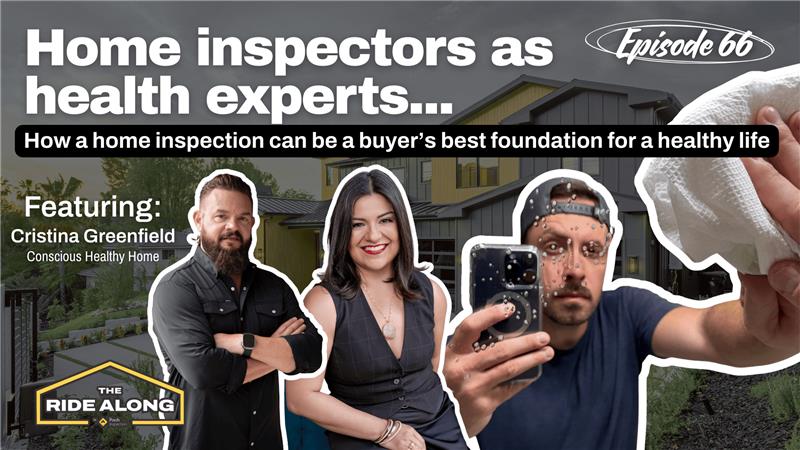
Healthy homes sound great – until buyers start asking questions you don’t have an answer for.
Episode 66 of The Ride Along puts that front and center. Brad and Matt are joined by Cristina Greenfield, founder of Conscious Healthy Home, former attorney, and certified Passive House Builder. She works with home inspectors and real estate agents on health-related housing issues and brings a super grounded take on a topic that’s easy to overcomplicate.
Bottom line: mold comes up, but it doesn’t HAVE to be a scare story. Air, moisture, and performance matter more, and inspectors are usually the first ones to connect the dots. No hype. No fear tactics. Just a real conversation about how homes behave over time.
Catch the full podcast here, and sign up for The Ride Along newsletter to get more episodes like this one delivered straight to your inbox.

Transcript
Brad Lowery
Guys, it is twenty twenty six. And man, if you’re already sick of things, well, this is going to be a great episode for all of y’all. You see what I did there, Matt? Hey, yeah, because we are talking today about healthy homes and why they matter and how we as inspectors can help home buyers get into truly healthy homes that are going to promote a truly holistic quality of life as they’re going about their existence, hopefully for years or more.
Matt Brading
I see what you did.
Brad Lowery
in this property that they’re acquiring. we’ve got a great guest for that today. But Matt, before we talk about that, dude is twenty twenty six man.
Matt Brading
All
Welcome
to . See, and that was a good lead in like this is a good way to go into with a health-conscious mind, right? Like I think that’s a great way. So yeah.
Brad Lowery
Yeah, everybody’s
doing dry January I’ve tried and failed twice. Okay, just being honest.
Matt Brading
I can’t, like I’m not telling you I’m doing dry gin anywhere. I can’t say that, right? However, because I’m gonna go there. I’m gonna get into that stuff, you know? But I mean, like I have cut down and really it’s not about the alcohol for me so much. It’s about the poor choices, like in terms of like food or late-night food or something that happens whenever maybe alcohol is involved. And so to try to…
Cristina Greenfield
You’re not declaring it.
Matt Brading
I need to trim some pounds, man, you know, and in order to try to remain focused on that, I decided to cut back on the alcohol a little bit. So, I mean, I’m not doing, I’m not doing dry January. I will be, I will be on it in January, but, I think it’s been almost two weeks since I had a that’s dryer.
Brad Lowery
It’s drier, know, it needs. But actually,
Cristina Greenfield
Dryer, that’s right, that’s right.
Brad Lowery
No, it’s like, know, Christina Greenfield’s our guest today. Let’s go ahead and introduce you here because you have, first of all, such a diversified background. And I want to tell some of the listeners about what you do because you have quite a insight into what holistic healthy living looks like and how it all starts with your environment. So please go ahead and Matt, first of all, introduce how you know her. And then Christine, I want to hear all about you.
Matt Brading
Right. But sure, yeah, well, you know, we’ve kind of been friends for a while now. We met through social media. Christina actually hired me to inspect her house. And so I did an eleven month warranty inspection. She lives relatively close to my neighborhood, or not neighborhood, in my area. And I actually did an eleven month warranty inspection on her house. And since then, we’ve just kind of become friends. And we have done a few things together in terms of educating and gotten together on some things that we are actually going to a little bit later because she has some things that she but before I go into that really I need to know like first of all welcome to the show and second of all like did our PR team take care of you like did you get everything that was in your rider are you good
Cristina Greenfield
Thank you. I did not get all blue M&Ms as requested, you know, everything else shook out, so I was gonna let that one slide.
Matt Brading
Man. Okay. All right. Well, we’ve got to work on that. It’s something new we implemented this year. Well, you know, but no, seriously, we, we’re so glad to have you here on the show. And I think really a really good place to start. You know, we had Matt rising her on last year in the middle of last year sometime. And one of the questions I asked him was, you know, how he defines a high performance home or high performance building. And so I feel like that’s a natural place to start with you. Like what exactly is your definition, of a healthy home.
Brad Lowery
Let’s get our background too, first of all. Yeah.
Cristina Greenfield
That’s a great question.
Matt Brading
Yeah, yeah, we will.
Cristina Greenfield
We’ll get there. We’ll get there. No, thank you guys. Thank you for inviting me on. I’ve said often, Matt, that our conversation should have been recorded as podcasts because they just roll and they just flow and they’re just so, so good. So, we’re finally doing it. I’m very excited to be here. You know what? That is one of his gifts. Yes. And I think it’s funny how you introduced me.
Brad Lowery
Are you saying he’s good at talking?
Matt Brading
Talk.
Cristina Greenfield
That’s how I introduce myself to you, is I lured you to my home. And I was like, oh, this is perfect. I paid, I paid.
Matt Brading
You, I mean, it wasn’t lured. Mean…
Brad Lowery
If you have to, you have to do little treats of bourbon like you know, bread crumbs.
Cristina Greenfield
Yes, yes, just the small ones. No, no. It was called hard cash, yes. that’s, you know what, actually that’s the best way that I’ve found to really like vet people is, you know, let them work on my house. So it’s been good, yes. So back to your question. What is a healthy home? You know, my first answer was gonna be it depends. It depends on everyone, but you framed the question, what do you define as a healthy home? So I’ll let you know.
Matt Brading
That is not what happened. It was actually cold hard cash. Yeah.
Cristina Greenfield
I think a focus on indoor air quality, super high for me. A house that manages water, so not just bulk water, but also vapor, super, super important. And then, you know, a house that’s well maintained. So that’s on, you know, that’s on my husband and I. And in order to maintain it, we’ve got a schedule, we’ve got monitors everywhere, so we know what is the humidity, how is each room looking. You know, we really, we have a dumb house purposefully. We don’t want a smart house, but we have little monitors everywhere so that we know kind of what’s going on in every room because, know, our philosophy is we are our own first line of defense and a healthy home is not built in a vacuum. It’s got to be maintained. And, you know, I’ve engaged with you, I think twice now. First at the eleven month warranty and then I think we did another one after. I think we did. I don’t remember. No, no, it’s only ever been you, Matt. It’s only ever been you. So…
Matt Brading
Yeah. Your other inspector. Hahaha!
Cristina Greenfield
But part of that is just making sure that professionals put their eyes on the house too, because we get so busy. And sometimes our home is just a place that we just come to sleep. And that’s where a lot of problems can arise when you don’t really know what’s going on with your home. So you can’t be proactive. Because some of those problems, they were a small problem to begin with. And then nobody did anything about them became a big problem. So yeah.
Matt Brading
Right. It’s funny because a lot of that seems to align very much so with a high performance home, you know, like as far as Matt was saying, you know, it wasn’t like a smart home or a home with all of these, you know, awesome, crazy technological details. It was really just one that works really well is really what he considers to be high performance. And so with that being said, like, you know, and like Brad said, like talking about like background, like
Cristina Greenfield
Yes. Exactly. It has to work well. Yeah, it has to perform.
Brad Lowery
Realistically, yeah.
Matt Brading
Like your origin, like how you ended up here. I mean, you have a bit of a story there. I think you let us know like what led you down this path. Like what was the turning point in life that let you down this path?
Cristina Greenfield
Yeah, absolutely. it was necessity. So I was just going on about my life. I’ve been a lawyer for fourteen years. So I was just doing my lawyer thing, making a lot of money and spending a lot of money. And my husband and I were, you we were just in the middle of it, young kids. You know, we had one baby at the time that we moved into this one house and then we ended up having another baby. And long story short, that house had a lot of hidden toxic mold. And so the symptoms started showing in my oldest daughter who was developing completely you know, on schedule up until the time that we moved into the home. And then it turns out through, you know, lot of testing, genetic testing, finding the right doctors after about four years of going through special needs because she was misdiagnosed with autism as a result of her symptoms. We found the right doctors and they asked the right questions. You know, what happened? What changed when your daughter’s development, you when you noticed the difference in her development and it turned out it was a house. So we went through an extensive remediation. We ended up you know, fixing the issue with that house, disclosing, selling, moving. And then our big dream was, well, I’m going to build, I’m going to build a healthy home. And I started on the path that like many people do, which is I don’t want that same mess that, that I had, you know, so my first thing was I want a mold free home. And then I figured out very quickly, that’s not, that’s not actually the goal at all. I started studying building science because I was really blessed to be able to have a great doctor. So I left all the health and medical to her. But I was like, I still have to find the right structure to put my family in and I can’t let this mistake happen to us again. And the mistake was, we hired all the right professionals when we bought that home, but we didn’t ask any questions. So we got the reports, we looked at the reports, we’re like thumbs up, thumbs down. Everybody was like thumbs up, we bought the house, and we bought all the issues that came with the house, right? So a completely kind of uneducated consumer. So I knew I had to change that. Right? Because I don’t live in a victim mentality. I’m not real focused on what went wrong, but I had to focus for my family’s sake on what we needed to do better to make sure that we didn’t have that situation again. So I became a certified Passive House Builder. And you’re familiar with Passive House because I know you’re familiar with Passive House. all in that. And that really helped me to understand the real issues, which are how homes perform. And it’s not mold. That’s the issue. is actually a symptom. So much like we get sick and we have a cough, that’s a symptom. Something’s going on in your body. When mold finds its way into the home, something’s going on with the home. It’s not managing water, it’s not managing vapor. There’s a leak. Something is going on. And so rather than living in that victim mindset and that fear mentality, I was like, all right, so what does it take for mold to grow? It takes air, takes water, it takes a food source. Okay, how do we control that? I figured out how to control that. And using my legal background, so I’ve just been assessing risk for fourteen years, right? I’m not a litigator, so I’m not the eye-op-chat lawyer, right? I’m the lawyer that my clients come to and they’re like, hey, we’ve got a big project and we need to get this deal done. We’ve got a merger, we’ve got an acquisition, we have things to do, right? So I’ve got to advise the executives and the board on risk all the time. And so that’s all this is. That’s all construction is, is advising people on risk. So you have to understand the risk. You have to understand the landscape. And that’s what I took on. And I just, I just started doing that for, for people going through remediations, renovations, or people like us who went through an experience that made them want to build their own home. And the very first question is, what is a healthy home to you? Because as you know, not an industry defined term, can’t just throw that blanket statement around and expect to get any quantifiable results.
Matt Brading
Well, mean, it’s almost like a buzzword at this point, like, that’s the deal. Yeah. But I mean, like the truth of the matter is it’s yeah, it’s very subjective. You know, what all of our wants and needs are different. So yeah, what is it to you? You know, one thing that I’ve always admired is like, you know, you said like, like you hold yourself and other homeowners like accountable. Like it wasn’t just like.
Cristina Greenfield
It is. It’s like green washed pretty much. Yeah. It is. Yeah.
Matt Brading
Fear driven or anything. I don’t mean to call anybody out, but I mean a lot of people in the mold community or anybody that’s had this issue, at times they can be pointing the finger a lot. And I mean, don’t get me wrong, there’s people and there’s things to blame, but you just have a completely different approach as far as learning what it is that’s going to cause these type of issues and how to prevent them. I don’t know, I just always admired that.
Cristina Greenfield
Thank you. I appreciate that. I work really hard at that because, again, with the legal background, have never been successful in convincing a counterparty anything different by berating them, by pointing the finger at them, by saying, it’s all your fault, you’re wrong, you’re terrible, you’re horrible. That’s not the way we move the needle if we want to see change in this industry and if we want to see people really being able to invest in homes that last hundred years.
Matt Brading
Yes.
Cristina Greenfield
So we have to find the middle ground and we have to understand this is all just risk shifting. What is the risk? What are we going to do? Who’s going to take it on and who’s going to pay? Right? I mean, that’s all it is.
Brad Lowery
Yeah. But there’s a good thing. Yeah. There’s a couple of things there that I really want to get into later in the conversation as well, specifically how older homes can be made to be healthy homes. Because again, there are houses that have existed for one hundred to two hundred years. They’ve been here a long time. I’ve gotten to inspect a bunch up in DC. There’s a ton of them here in Nashville, where I live now, and even back in Florida as well. But the trick is like, there’s people that will come in and they’ll renovate and modernize and update some of these.
Cristina Greenfield
Awesome.
Brad Lowery
Now Matt and I, we’re trying to go and look at, did they heavy up framing properly? If they put an addition on to what was once a small house, is the load supported correctly? Was the old crawl space encapsulated properly? These are all things that can contribute to healthy homes, but there’s a proper way also, I think, to truly ensure that the houses will last for another hundred years in terms of actually being clean places to live so that folks are holistically well while they’re there. But let’s circle back quickly on passive homes because you know what that is, Matt knows what that is, but there’s not going to be a lot of inspectors that understand that term. in effort to prevent there being another buzzword, let’s talk about that. What is a passive home for those that don’t know?
Cristina Greenfield
Yeah. Yeah, so passive.
Matt Brading
That isn’t a bug word, yeah, that actually is specific.
Cristina Greenfield
It’s yeah it’s a real thing. So passive building is building methodology that was started in Europe and the very simple explanation is it focuses on the building envelope first which genius right. And so with the with the building envelope and with a level of air tightness which is far above code. Managing water, managing vapor, having all the control layers being continuous. They talk about like a red pen test where if you’re looking at the actual drawings, you should be able to trace without picking your pen up the various control layers, air, water, vapor, thermal, right? There should be no breaks. That should be continuous and that way you have the full protection of what each of those layers is supposed to do. But it starts with design. In the passive house, it starts with design. You focus on the building envelope and then some people you know, automatically are going to say, no, we know that there’s a lot of dangers with tight houses and tight houses are very, very unhealthy. And so passive house is not the way to go. Well, to those folks, I say, well, then it hasn’t been done. It’s a system. It’s not just the envelope. We start with the envelope. It’s not just the envelope. It has to be a well-balanced and designed and installed mechanical system as well that accounts for expelling and bringing in air through dedicated areas as opposed to construction defects. Right. That’s the trade off. When we make a house tight, we make sure that you’re not getting any of that air infiltration or exfiltration from places that aren’t actually filtered. So fresh air, healthy home. And so, yeah, so that’s what Passive House is and it’s incredible network. I have found so many professionals because I don’t represent myself as being somebody who’s been in the construction industry their entire career. have not. But what I think is great about that and why I have no ego about that at all is I think because it’s learnable. It’s learnable.
Brad Lowery
Yes.
Cristina Greenfield
You know, and you should be empowered that it’s learnable. You as a homeowner need to know. You might not have to go crazy into the details, but you need to know what you’re looking at, what you’re asking for, what you’re talking about in order to make sure that you set yourself up for success, you know, with these professionals. But I think Passive House gets you for a healthy home. Passive House gets you most of the way there. I think what that methodology doesn’t necessarily talk about is material handling and specifications. And so that’s where you really start thinking about healthy materials. What are you doing? How are they getting delivered to the site? Where are they being placed? How do you quantify when you should be able to go ahead and dry in? How dry is dry enough for the framing? so those things aren’t, they’re not really built into passive house. But that’s where my methodology when I’m working with homeowners is.
Brad Lowery
Nah, that’s massive.
Matt Brading
Right.
Cristina Greenfield
I’m saying, there’s tests that Passive House will support a healthier environment and then we need to layer these other things on if in fact that is how these individuals define healthy home, that they need those types of things.
Brad Lowery
Now, that’s brilliant, absolutely, especially because, know, Matt and I, both see properties and neighborhoods that get chucked up so fast during the most inopportune season simply because it’s, you know, construction right now is all about meeting demand where supply has been lacking for so long, you know. So they’ll skip over all these things. The houses won’t get dried in properly. And when they do start the drying process, everything has been soaked for so long because they’re building during the wet season.
Cristina Greenfield
Yeah. Yeah, that’s hard.
Brad Lowery
But so that’s something to consider there. But, you know, we’ve mentioned some absolute standards when it comes to passive house. And then we’ve also talked about how healthy homes can be relative. as someone that looks for objective truth in an age of nuance, in a world of nuance, what are some things that might be misconceptions about a healthy home or a passive
Cristina Greenfield
I like that. Things that might be misconceptions about a healthy home. think that people believe that if a home is new, it should be healthy. And just like as a blanket statement, right? Even if it’s a production builder situation, they’re like, it’s brand new. This home should be perfect. I should never have to touch it. I shouldn’t have to look at it. And to those people, I try to help educate them. Again, going back to the fact that a healthy home is not built in a vacuum. But also just understanding the nature of the production build environment, which I’m not knocking. There’s certainly a purpose for it. But you have to know the limitations. Like you said, it’s a environment that’s built for volume, right? They’re building the same thing over and over again. They’re doing it quickly and they’re selling them quickly. And so to build a home that has a level of air tightness and that actually manages the control, you know, with the control layers, it takes a really skilled labor force to do that. That’s not just anybody just doing it quickly with no oversight. And even people who are skilled and do it a lot still appreciate the oversight because things can be missed. We’re limited by our own senses, right? And so I think that, and I almost blame it, not blame it, but maybe attribute it for myself really to the age of HGTV. Like many of us really grew up watching HGTV, loving HGTV and watching all the, you know, this guy, this one person is like a butterfly hunter and this other person is, you know, I don’t know, I don’t know what they are, but like these crazy careers that you’re like, yeah, and they have these incredible budgets and all they’re doing is aesthetics, you know? So we walk into a place and we’re like, ooh, how can I change these countertops? How can I add wallpaper? You know, and all this stuff. And we’re really focused on aesthetics when really we need to be focusing for our own health and for the benefit of our investment.
Brad Lowery
Yeah.
Matt Brading
Yeah, for sure.
Brad Lowery
Yeah. I did stick my head in here.
Cristina Greenfield
We’ve got to be focusing on things we can’t actually see.
Brad Lowery
Entertainment, education. That’s, it’s honestly it is. And you on your Instagram, you hit on this as well. That I guess in twenty twenty five, healthy homes kind of became a buzzword. And there’s some misinformation that kind of crept into the influencer space around healthy homes. People that only get their education from, you know, HGTV here, let’s put some gray paint on the bathroom and call it a flip.
Cristina Greenfield
It’s tough. Yep.
Brad Lowery
Or, you know, I’ve walked into houses and customers have leaned right up against the load bearing wall and go, can we just knock this out? And I’m like, you like property brothers, don’t you? They’re like, we love them. Yeah. Yeah. But yeah, right. Yeah. But it’s even more accessible now because of TikTok and Instagram and things like this. So how can home buyers kind of weed out fact from fiction so that they’re better educated?
Cristina Greenfield
Yeah.
Matt Brading
Cheers.
Cristina Greenfield
I I
Matt Brading
I’ve seen him do it.
Cristina Greenfield
Yes.
Matt Brading
Yeah.
Cristina Greenfield
I would say just be very discerning where you get your information. And if it seems too easy and too good to be true, it probably is. I don’t think that building a healthy home has to be difficult and it’s not unattainable, but it does take a level of knowledge and understanding of several different industries to really know what you’re doing and what you’re getting at. personally, if I absorb or and take information and it makes me feel scared, I automatically stop and I’m like, who has something to gain out of me being afraid? Because anytime I’ve tried to educate somebody, and if I really have an intent for them to understand, I want to remove fear. I want to give them information to help them make an informed decision. I don’t want to be the boogeyman saying, if you don’t hire me or if you don’t work with me or if you don’t know the secret thing that I know, you’ll never be able to have a healthy home. And I’m not saying all influencers are out there saying that, but that’s an exaggeration of some of the level of information that’s out there for clicks. And so just kind of think about where you’re consuming information. If it’s from an algorithm-based source, then there’s probably some behavior modifications and maybe the presentation of the information that could be a little bit exaggerated. And from my experience, there’s always a middle ground. It always depends. You know, so like people are saying one type of material is bad all the time. It’s not, you know, it’s not. It depends on so many different things. And so if you have a house that has that type of material and now you feel terrible about your house and your investment and you’re scared, I mean, what a terrible thing to do to people, you know?
Matt Brading
installation.
Brad Lowery
I like the flood-based paint or Chinese drywall, you know.
Cristina Greenfield
Well, yeah, there are exceptions. Yeah.
Matt Brading
Different story, but I completely agree with that. You can sit here and say, you know, X thing or X builder or X product is terrible, but in all actuality, it comes down to whatever product or whatever specific person was involved, how this thing was installed. Like there’s so many factors. You just can’t say that. I could probably find a couple of.
Brad Lowery
It’s a bit so high we can walk around on.
Cristina Greenfield
The state the material was delivered in. Yeah, it’s not a blanket statement.
Matt Brading
You know, products that I would say, nah, stay away from that like completely. But like for the most part in general, like it really could. There’s a whole lot of depending factors. It depends. Like we can say that all the time. So like as inspectors, you know, we’re always finding things like moisture, ventilation problems, you know, air leakage, you know, if we find that kind of stuff. But I mean, like, you know, at what point does something that maybe seem minor?
Cristina Greenfield
Yeah, it depends. Yeah.
Matt Brading
Like, do we need to like start focusing on like, because it can have some bigger implications down the line? Or what are some things that like, from your point of view that you wish inspectors would maybe focus in a little bit more on when we’re looking at it from the perspective of a healthy home?
Cristina Greenfield
Yeah, humidity comes to mind. So, and I think, you know, from an inspection perspective, It would be great if there was an inspector who consistently reported and actually emphasized, hey, you’ve got elevated humidity here. What we really want is below sixty percent, below fifty-five percent would be great. We’re looking for that. And I noticed in this room, it’s seventy-eight. And in your back room, it was actually fifty-five. And so there’s a potential that maybe we need to look a little bit further into the window, for example. Maybe there’s an issue with the flashing that’s causing this room to have more humidity. But I think humidity is a really great It provides a great map if you know what you’re looking for and why you’re looking for it. think that individuals though, people, homeowners, we need to be monitoring our humidity as well. But also just asking, yeah, and asking your inspector, hey, with your tool that’s probably a lot better than my little Amazon hygrometer, could you check? Could you see what the, could you set that up when you’re doing your assessment? Maybe first thing you go set your thing, your monitors up and.
Matt Brading
Yeah. Is it changed?
Cristina Greenfield
With your specialized tools, be able to help me understand some humidity tracking here. That’s one thing that comes to mind because nobody’s focusing on that.
Matt Brading
In our climate, no, nobody is. And in our climate, it is a really big deal. I mean, for me, I can’t say that I focus on it. I don’t have any specialized tools like tech check humidity in different areas of the house. I’ve been carrying around like a rather nice, I’ve got one, what’s that? Aronet Home, have you ever heard of that one? I carry that one around.
Cristina Greenfield
Yeah, yeah, yeah.
Matt Brading
And it just is in my gear, usually in the kitchen. Usually I can get a reading on it. You know, can check the thermostats and stuff. The thing is for me, like a lot of times when I walk into a house that has humidity problems, I can feel it. I can smell it. You know, like it’s just there. And now this time of year, you know, it’s a little bit more difficult because we like yesterday, I think it was yesterday, day before, something like that, were doing an inspection in the evening on a house warranty inspection and
Brad Lowery
Yeah, you know.
Cristina Greenfield
Yeah, it just sits. Yeah. Yeah.
Matt Brading
And first of all, talking about humidity, mean, this is one of these things that like as an inspector and someone that’s fascinated with building science, I’ve had to, I’ve continually gotten educated on that. I can tell you that I have more of a grasp on dehumidification now than I did even a year or two ago. Um, I mean, there was a time, cause it’s just not part of our scope. Really. It’s not, um, find it. Well, it is tough to do, but like the find and at least the Texas SOP, like humidity ain’t there. Like it’s not, it’s not mentioned.
Brad Lowery
It’s tough to do. mean, yeah.
Cristina Greenfield
Yeah. Yeah.
Matt Brading
And, um, and so, but, yet it’s one of the things that’s killing our buildings out here and making a lot of causing a lot of problems and causing a lot of homeowners, a lot of health issues, or it could be a contributing factor anyway. And it’s, can be from a, a series of different things. Most of the time it seems, uh, first of all, I’d say every house needs a dehumidifier. Second of all, um, pressure imbalances all always, almost always related to HVAC. Um, you know, air intakes bringing in too much air. There’s all kinds of like contributing factors. Um, but, but I have you know, had to have conversations with people this time of year. It’s a little tough. I’m like, I’ll look at them and go, what’s your humidity like during, the summer? And sometimes they’ll go, oh, it’s not bad. Like it’s in the sixties. And I’m like, well, you know, that may not feel that bad. Um, I walked into a house the other day. It was about twenty six hundred square feet and it had a four ten AC for a house that was built one year ago. If I’m just judging by the size of the house, granted, not doing a manual J calculation.
Cristina Greenfield
Hmm, yeah.
Brad Lowery
If you stick off tonight, it doesn’t hurt.
Matt Brading
from the size alone, house versus condenser, that was a little bit big. And so I was asking them where their humidity was at and they told me, no, no, it’s great. It’s like in the sixties. And I’m like, well, it shouldn’t be in the sixties. So of course, they’re one year, they got another year before their HVAC warranty expires. And I’m like, hey, monitor that, get you some. And this is what you were talking about, you know, cause as homeowners, I mean, we can only do what we can do as inspectors, but my advice was get some hygrometers, put them in that different rooms.
Cristina Greenfield
Yeah. Yeah.
Matt Brading
Find out where your humidity is at because there’s a chance that you have something going on or your HVAC system might be improperly sized. And that can be creating some humidity issues because you need to be in the fifties or below. Like you need be fifty-five or below. That’s where you need to be. If it’s hitting that sixty mark, we’re in an area where it could be a problem. It’s, once you get above that, of course we’re getting more problematic the higher you get sevemties, we’ve got a real problem. And so, and this is the things I don’t think everyone knows.
Cristina Greenfield
Yes. Yeah. Yeah. You have a real problem. Yeah. No.
Matt Brading
And I can tell you as a home inspector, when I started, I didn’t, I didn’t know that either. And so, so I think you’re right. Even if it’s as little as having the grasp on that,like where is a healthy level of humidity? Like for a home? I think that’s important.
Cristina Greenfield
Yeah. Yeah, yeah, yeah. And it would be, like you said, even if you could set up like one monitor when you begin your inspection in the kitchen. And if you get a rating of seventy, then you might be, well, you might wanna have further assessments because like for a mold inspection, for example, they’re always gonna assess humidity. Right. Because they know that that’s a driving factor for microbial growth. And the reason why there’s a range, some people are like, know, some influencers are saying at fifty-five percent, like if your hygrometer says fifty-five percent, suddenly automatically you’ve got mold everywhere. And I’m like, no, that’s not, it’s got to be, you know, it’s over a period of time. It’s sustained where that’s what you’re trying to find a trend. It’s not nothing in a vacuum, but also these monitors, even the ones on the wall, especially.
Brad Lowery
No
Cristina Greenfield
Are usually off by a few percentages, you know? And so if you’re getting a sixty percent reading on the one at the wall, it’s probably actually higher. You’re just not getting that. And with some species of mold, they’re actually called self-originating molds. And you probably know this, but they grow at sixty percent humidity. So all they need is humidity to grow. They’ve already got the building material, air is all around. And so with that, you know, sixty percent humidity, they’re able to kind of flourish. And those are some of the…
Matt Brading
Yeah, they’re not calibrated.
Cristina Greenfield
The molds that you will find like in the wall cavities and things like that. So over the same period of time, if people don’t know what their humidity is, but you know, they’re thinking that it’s on the higher level, that’s why that fifty to fifty-five percent is ideal because at sixty, because we don’t know, you know, if their monitors are accurate, right? So like at sixty, you’re like, you need to really look at that.
Brad Lowery
I also wonder when it comes to testing processes, if at the beginning of the inspection would be the right time because some of the factors that are going to play into humidity levels at home also depend on how many kids are in the house. Are they coming and going in and out of the house? Is the door going to be possibly open and closed? Are they like my mom who, as soon as it’s a sixty degree day, opens every window in the spring because we need to air the house out.
Matt Brading
Yeah.
Cristina Greenfield
Yeah. Yeah. Yeah, yeah, burp in the house. Yeah.
Brad Lowery
Right. Yeah. And so, I mean, there’s things like that. And when you’re doing the inspection, there’s a lot of in and out, at least, you know, I do the exterior first and then come to the interior. But just that little bit of opening and closing people coming and going from the inspection. I wonder if that would be enough to throw it or if it needs to be tested more like radon where it needs to be closed home conditions.
Cristina Greenfield
Yeah, you’re right. Yeah, you’re probably right to actually get it to get a true to get a real true reading. Yeah. Yeah, yeah, that’s it. That’s a really good point. And I think I think the other one, Matt, remind me, do you do you actually look at the HVAC system like you go up and you look in the attic and you sort of like look at the HVAC, but you don’t touch it or get into it, right? During your inspections or no? Yeah. Yeah.
Brad Lowery
But you could do it at the same time as a radon test, as an ancillary, you know?
Matt Brading
Yeah. I don’t take it apart. I look at everything I can see. I’m fortunate whenever there’s like an access panel to look at the evaporator coil. I got a funny story about that. You know, most of the time whenever they install, most of the time when they install these HVAC systems, they don’t leave an access panel for us to look at the evaporator coil. But if they do –
Cristina Greenfield
Only in this group would it be like, I have a funny story about an evaporated girl.
Matt Brading
Or, especially like if it’s an older house with a replace unit, sometimes they leave one of those. There’s an access. We’re going to open up. We’re going to look at that, right? Because that could be a really good spot to determine what’s going on inside there, right? If it’s dirty, nasty moldy, we got a problem. If it’s clean as a whistle, great. But I would say ninety-nine percent of them we can’t see. It’s, and I mean, ninety-nine point nine percent of new construction houses. I’ve only seen it one time and it just so happened that two units.
Cristina Greenfield
Mm-hmm. Mm-hmm.
Matt Brading
You know, side by side in the attic and they had the access panels. So we pulled them, we looked at them and in one of them, there was a ton of water sitting in the bottom of it, which wasn’t supposed to be the case. Like the coil was sitting in water. It wasn’t draining properly. Not supposed to do that. And then the other one, the coil was damaged. You could see all these dents in the, the, in the coil and all the fins were damaged and everything. And so we’ve got pictures of both of those things. And then, um –
Cristina Greenfield
Not supposed to do that.Wow.
Matt Brading
I was driving to another job like the next day and I got a call. My wife handles the phones for the office. She goes, hey, I got a call. You’re supposed to call this builder back. And it was a guy had met him. His name was Jake. We’re going to say his name with Jake. Not Jake from State Farm. Another drink. So I said, uh, she goes, you apparently something about you guys checking the AC wrong and opening it up and weren’t supposed to look inside of it or something like that. And I was like, what? And so about the time I went and looked at the report and I realized, yeah, those, yeah, like we looked inside of them because we opened the access panel. And so I called Jake and he said, yeah, man, never mind. Like he goes, the AC company called and they were livid because they sent the report to them like, hey, you guys fix this stuff. And the guy was like, that inspector has no business dismay, he had to dismantle the unit to look at that and all this. He went off and just let him have it. And then Jake said he went up into the attic and goes, I’m pretty sure they just opened this access panel here. Exactly what we did. He looked at it. goes, yeah, man, looks just like the picture. But yeah.
Cristina Greenfield
Wow, my gosh. What a funny reaction, not like, my gosh, that’s something that needs to be fixed. was like, hell, they shouldn’t have found that. Okay?
Matt Brading
They shouldn’t have found that with his reactor. Exactly.
Brad Lowery
They shouldn’t be doing their job.
Matt Brading
Crazy, crazy. So obviously didn’t want to pay to go fix it. I mean, it’s not our problem. Anyway, good thing we found it. But we wouldn’t have found it had we not had access because we are going to dismantle this. We do look at the unit, see how it’s put together. We oftentimes see a bunch of air leaks around the coils. They don’t do a good job sealing around that ceiling to the furnace to the plenum. We see leaks in the plenum. We man, I can’t tell you how many times, especially during the summer.
Cristina Greenfield
That’s wild. Yeah. Yeah. Yeah. Yeah.
Matt Brading
You know, we can see what I can only describe as probably a pressure imbalance causing a massive amount of condensation to form on the underside of the evaporator coil. And it’s just raining into the pan, you know, and it’s the end. That’s a real problem. Every time you see that there’s other problems down the line. So, yeah, we’re not dismantling anything, but there’s a lot of things. If you know what you’re looking at, there’s a lot of things you can look at and try to make some determinations.
Cristina Greenfield
Yeah. Yeah.
Matt Brading
You know what might be causing problems. And that’s our job, right? We go up there and we’re like, Hey, this isn’t right. This problem right here shouldn’t be happening. This needs to be further evaluated. That’s what we do. Right? I try to get as close to, and this is everything I do. I try to get as close as I can to finding what I believe to be the, the, the culprit. Because if I can hold their hand and say, right here, here is your problem. Look it here, then-
Cristina Greenfield
Yeah. Yeah. Mm-hmm.
Matt Brading
My clients tend to see a little bit better results. And so through my experience, I’ve learned to try to trace that down as narrow as I can. But still there’s a limit to what I can do. But really the idea in the name of the game is figuring out a reason to have, and not a CYA reason, not just like, I’m gonna have somebody look at it because I don’t know what I’m doing. Like if there’s something wrong, we ask somebody to come take a look at
Cristina Greenfield
Yeah. Absolutely. Well, it’s a part of a system that requires a licensed professional to look at it, then a licensed professional needs to go look at it. mean, that’s just, you know, that is just gathering information, which I think is really valuable. And that’s one thing that I really appreciated about your reports, is that they were really written in a way that, you know, I could read it and I could say, okay, I know what needs to be done. Okay, I can make my checklist of like, this needs to be done now. This can be done next year. You know, it is. that’s one thing that think homeowners, if they’re not already doing that, when they get your reports, when they get reports from inspectors, you need to put it in your binder, your home binder, highlight the things and categorize the things that you’re going to action now or later. Because, you know, especially if it’s a new home inspection, you can get ahead of issues, you know, but you can’t ignore issues and expect that you’re not going to have a problem after the warranty’s already expired and now it’s all on you.
Brad Lowery
Well, I want to talk about getting ahead of issues. And one of the things that I loved on your website and on social media is how you talk about that process starts from the site selection, from the point of the site selection. A healthy home isn’t just an existing structure. It goes even into the planning of where you’re to put the house. And one of the things that people don’t often think about, because again, we’re kind of constrained a bit more often than not to the decisions of builders when they’re putting in neighborhoods and subdivisions. But I’ve seen so many of these houses that are backing up in these subdivisions right up against or right behind massive high frequency electrical towers and electric lines. And you point out that there could be potentially hazards from electromagnetic fields when you’re exposed to those over a long period of time. And while some studies suggest that those EMFs could kind of drop off after about six hundred fifty feet, stepping away from them. Still, you’re talking about a thirty-year or more investment and where you’re going to be existing as a neighbor to this crackling power line for decades. So what studies are out there as far as the potential effects that those can have in terms of your long-term?
Cristina Greenfield
Yeah. Yeah, so I think that that’s really a developing area of research. So I’m certainly no expert in EMF. There are other building biologists who actually study that as a core piece of their coursework. And those people can be find on buildingbiologyinstitute.com. Find a professional and you’re looking for somebody who can specifically measure EMFs. There are some individuals who seem to be more symptomatic when they are close or exposed to a lot of electromagnetic frequencies. And I think just from a very high level, the idea that electromagnetic frequencies could impact our health makes sense to me because, you know, it’s just, like we’re, there’s definitely a communication between. like the cell phone and the cell phone tower, like something is actually there, you know, and our bodies are made of soft tissue. And so if we’re constantly exposed to whatever is being transmitted, maybe it’s because you already have a sensitivity and so you’re more susceptible, similar to mold and mold exposure. Like not everybody’s going to have the same symptoms, but depending on your toxic load, you may experience it differently, you know, more pronounced than other people. I think of electromagnetic frequency as the same. And there are studies actually that show that electromagnetic frequencies, I think it’s by Dr. Klinghardt. I have them listed on my website, different resources that people can go look at and kind of determine for themselves if it might be an issue. But yeah, but there are studies that show that the electromagnetic frequencies actually exacerbate, they could be exacerbating mold growth. And so they had like a control substance and then they had another substance next to the EMS and that-
Brad Lowery
An excellent site, by the way.
Cristina Greenfield
That sample seemed to grow more than the one that was not close to the EMF. So very high level understanding of that. But I mean, it seems to me like it could make sense. Personally don’t feel like I experience any difference around electromagnetic frequencies, but there are really simple things that people can do if they’re concerned about that. You can just make sure you turn your Wi-Fi off at night. Like you’re not really using the internet, you know? So just turn it off. Get a kill switch. Turn it off. Don’t have
Brad Lowery
That’s what Verizon did to all of us yesterday.
Cristina Greenfield
See, they helped you out. Yeah, like turn it off. Don’t have things that are plugged in next to your head as you’re sleeping. And I think that if you think about kind of creating a sleep sanctuary, so free from dust and dirt and clutter, but also free from any frequencies, if that’s something that you’re concerned about, the changes are really simple. It really just requires some habit, some habit changes and some just kind of analysis of whether or not that’s something you’re concerned with.
Brad Lowery
Yeah, what a nice, day.
Cristina Greenfield
But yeah, that’s, you know, sometimes in the healthy home community, that’s something, and I’ve had it especially on social media though. I don’t really have any clients currently that have this as a particular concern. Now everybody says, I’m interested in that. I think, you know, I would like to make changes that make sure that my home is not as exposed to electromagnetic frequencies or, high voltage power lines or anything like that. And so, but when it comes down to like a dollars and cents perspective, the clients that I have right now aren’t particularly sensitive, so they’re not really willing to make any investments that would actually affect the bottom line. If there are some changes that they can make from design perspective that don’t change the financials at all, then they’re willing to do that. But there are some people who are very, very concerned, very, very susceptible. Yeah.
Brad Lowery
Yeah, sure. Definitely. And then you hit on something else there too, where kind of some of this comes down to the things that a homeowner and a home buyer can do in setting up their house after they’ve acquired it, right? Creating a sleep sanctuary being one. So how much of a healthy home falls on the buyer as opposed to the builder? Because I’ve told buyers before,
Matt Brading
But.
Brad Lowery
Especially when dads have asked about the state of a house, I had a dad ask me before, like, so you’ve inspected this neighborhood before, right? And I was like, actually it’s my first house in this neighborhood. He goes, so can you tell me how it’s gonna hold up based on what you’re seeing with the neighbors houses? And I’m like, well, I’ve never been in the neighbors houses, but I can tell you that after one week, if you put ten different families ten different houses in the same street, after one week, they’re all going to be different.
Cristina Greenfield
I just told you that. Yeah.
Brad Lowery
So just based on how those people treat the property in the building itself. So how much of that falls on buyers and what things can they do as we pivot toward that in creating a
Cristina Greenfield
Yeah. Yeah. Yeah, I think you can’t out maintain a bad structure. You know, you can’t. And so I think that relying on inspections and really investing in your inspections. So not kind of value engineering and looking for the cheapest inspector to come out and just give you a piece of paper and tell you everything is fine. Like actually approach with curiosity and openness. And I would even say if you get an inspection that’s completely clean, there’s something was missed.
Brad Lowery
True.
Cristina Greenfield
You know, is, mean, construction is a messy business, you know, things are going to happen and need to be improved. I wouldn’t be afraid of that. I would, I would take that information as something that I could action, you know, and I could either ask the builder to do it, or I could take that on myself, figure out how much that investment is going to be, maybe negotiate a price difference, you know, but I would be, I would be very, very curious and be really, really invested in just, just collecting information.
Brad Lowery
Right, yeah.
Matt Brading
I completely agree. If you get a clean inspection for back something is wrong. Your concerns should be that you didn’t get the value of your inspection and folks you heard it here. She said it don’t just get the cheapest inspector. She said it. Okay, we’ve said it to you before.
Cristina Greenfield
Yes. Yeah, you need a second opinion. Mm-hmm.
Brad Lowery
Yeah, every inspector needs to go follow Christina Greenfield right now just for saying that.
Matt Brading
You
Cristina Greenfield
But it’s so true, it’s so true because you’re out there, you’re doing a different job than someone who’s just looking to collect a fee to show up. You’re doing a different job and you’re actually providing a skilled service and skilled services should be compensated accordingly. It’s important.
Matt Brading
Yeah. Yeah. I think a lot of inspectors are doing that. I there’s certainly some out there that are not pulling their way. There’s still those. That’s going to be the case with everything. But I do think, yeah, I agree that specialized services should be paid for your work. Now, we’re talking a whole lot about buying homes, new homes, construction. But like, what about the pre-existing homes that somebody that’s out there that actually is interested in making their home a little bit? They’re a little bit health conscious. They wanna make their home a little bit healthier. They don’t know where to start. What’s some low hanging fruit options where homeowners might be able to start working their way towards a healthier home?
Cristina Greenfield
I love that question. actually just joined this group. It’s called Reimagine Buildings. And so for the most part, it’s a lot of passive house professionals, but it’s really anybody interested in high performance homes, professionals interested in producing high performance homes. And we did a group kind of case study on retrofits. And so retrofits is distinct from just like a HGTV cosmetic, know, fixer upper or whatever, but like actually trying to get an older home to perform better. And what we kind of landed on is you’ve really got to assess, fully assess the current state of performance of a home, whatever age it is, before you decide how you’re going to really tackle making this home better, healthier. and knowing what healthy means to you. what actually is your goal? If your goal is more airtight, if your goal is preserving the structure, if your goal is preserving the control layers, then you’re going to be looking at the building envelope. But really first, you’re looking at the mechanical system because God forbid, you take a home down to the studs or you do any kind of extensive remediation, renovation that requires all that kind of peeling back at those layers and you haven’t assessed the mechanical system because now you’re just circulating terrible air, you know, from a terrible system in that beautiful new envelope, right? So, and really the, can, you will, you will destroy all the work you did. So prepare to do it again. And some of my, some of my colleagues kind of in the industry, you know, they say a lot of times, you know, if they’re, if their bid was a little bit higher than someone else to perform whatever service installation, HVAC, whatever, you know, they’re like, okay, just keep my number. I’m here for you. You know, if you need it, just know it’s expensive the first time, but it’s real expensive the second time.
Matt Brading
You could destroy all the work you do.
Brad Lowery
Correct.
Cristina Greenfield
You know, and that’s true. That’s really, that’s really true. Yeah. So, I think that I would start and what I always advise my clients who are kind of looking for this, would say first, first, what is your budget? What are you looking to spend? ifIfhe budget is close to nothing, then we’re talking about maintenance, you know, and we’re talking about a maintenance schedule. We’re talking about your cleaning schedule. We’re talking about maybe changing your products that you’re using so that you’re not, you know, unnecessarily polluting your environment with toxic products, getting all the dust up.
Matt Brading
Yep, yep. And you’ve already put all that money into it.
Cristina Greenfield
you know, not stirring it up because whatever’s the, you whatever’s up comes down, right? So if, for example, there could be microbial growth in the home, it’s sporing, it’s falling in the dust, pick up the dust before you inhale it, you know, just pick it up. So we’re talking about maintenance from that perspective. If you’re interested in like a, in a true retrofit, then I would start with assessing the performance and I would start with assessing the performance of the HVAC system and then the envelope. Short to follow and I think those two things have to be updated. think unfortunately, and you guys probably see this too, you some people are like, okay I’m going to get these energy efficiency credits or whatever, know, whenever the IRS was offering different rebates and things like that. We had some energy efficiency updates but people were just getting the update for the credit and they weren’t really thinking about how that update could contribute to, are you okay?
Brad Lowery
We gotta redo this. My dog decided to just knock everything over. Hold on.
Matt Brading
We have a-
Cristina Greenfield
That’s funny.
Matt Brading
We have a situation.
Cristina Greenfield
We have a situation.
Matt Brading
Clean up one on nine. We can’t. This has got to stay in there like we can’t we can’t read it. There’s no way we’re taking this out. There’s absolutely this magic. Great. We should we all do it to make him feel better? You know, like whenever everyone’s like, Hey, everyone feed their pants. We’ll just walk over our stuff now just to make Brad feel better.
Brad Lowery
My gosh.
Cristina Greenfield
That’s so good. We need to see the dog. We need to see the culprit.
Brad Lowery
Lose, lose, lose, lose, lose, lose, lose,
Brad Lowery
Is true.
Cristina Greenfield
Yeah, knock it. Who does it?
Brad Lowery
Cheese and rice.
Matt Brading
Hey man, it happens man. I’m just glad I’m not the one having technical difficulty yet. Because the show’s not over.
Cristina Greenfield
Yeah, yeah, I know. We’re
Brad Lowery
Ugh.
Cristina Greenfield
right behind you. We’re right behind you.
Brad Lowery
Now it’s crooked. Hold on.
Matt Brading
Not really good, but I got way too much above your head. But but anyway, all right. Well, are we still rolling? We’re not gonna cut this out, right? Because we’re gonna leave it. We’re gonna leave it. We’re gonna leave it. Well, with that being said, I feel like I have to do something here, right? First of all, it’s kind of funny what you were saying because it’s like, okay, you want some low hanging fruit about what you can do have a healthier home clean your damn house. Clean up.
Cristina Greenfield
It looks good. Their lighting is great.
Brad Lowery
No, we can leave it.
Cristina Greenfield
Yeah, just keep rolling. Yeah. We’re gonna leave it. What? Clean your house. Take your shoes off.
Matt Brading
Just this place, for the love of God.
Cristina Greenfield
Wait, do you guys keep your shoes on in your house? I have to know. The viewers need to know.
Matt Brading
Most of the time I do, but most of the time it’s house shoes. Yeah, I mean, I’m very guilty of outside shoes coming in. I mean, I have dogs. It’s like sometimes I say, well, what the heck? I don’t like it. I’ve tried to get better about it. Something kind of did all I did. There’s never a thing growing up for me. Like shoes are kind of always on. I also have foot problems. So like a shoe has to be on my foot like period. I ain’t walking barefoot. And so it really just depends.
Cristina Greenfield
But not your outside shoes, not your outside shoes. Yeah. Yeah. Yeah, yeah. Okay.
Matt Brading
But I do, I think for the most part, we’re not in our shoes in the house mostly. Yeah, I mean, that’s it, low hanging fruit, definitely taking shoes off when you’re in the house. Hey, we gotta do something.
Cristina Greenfield
Okay. Low hanging fruit. Brad, are you a
Brad Lowery
So how about this?
Cristina Greenfield
Shoe on or shoe off family?
Brad Lowery
Well, it’s a it’s a slippers inside and then they’re outside shoes. You take them off when you can. It’s a pretty strict thing for me. But here’s the thing. How about this one, guys? Since we’ve been interrupted by it. Pets. Honestly, pets bring so much from the outside in and they can mess up your home studio podcasting setup.
Cristina Greenfield
Yeah, outside shoes outside. Yeah. Yes.
Matt Brading
Is that a strict thing?
Cristina Greenfield
They do. Hahahaha
Matt Brading
I would had like to mention something though before I mean while we’re on that topic we are-
Cristina Greenfield
No.
Matt Brading
All three doodle owners. You’re all three golden doodle owners actually.
Brad Lowery
Yeah, we are. That’s Yep. Yes.
Cristina Greenfield
We all have doodles. Yes, yes.
Brad Lowery
So in this portion that we were, we were wonderfully interrupted by my dog. but anyway, yeah, no, mean, truly though, they, they are probably one of the biggest reasons that dirt makes its way inside. Dust makes its way inside.
Cristina Greenfield
Ha! Love dogs.
Matt Brading
One hundred percent
Cristina Greenfield
Yes.
Matt Brading
Yeah totally hey guys we gotta gotta we gotta stop we gotta stop we gotta do the drink of the day we have got to do the drink they were gonna run out time we gotta do the drink of the day sponsored by GetSync.
Cristina Greenfield
Yes. So I have,
Brad Lowery
We do need to actually do the drink. Sponsored by GetSync, yes indeed. So go check it out guys. We’ve talked about them in previous episodes. GetSync is wonderful if you’re looking to modernize and automate some of the processes in your business. You can go to getsync.pro to learn more. But you know, we haven’t really gotten to it yet today simply because the drink of the day, none of us are really drinking because we started recording this at pm on a Thursday. Yeah. But, and yeah, we rolled right into it too. But before mine’s gone, let’s do it. So first of all,
Matt Brading
We’re just having too much fun.
Brad Lowery
Thank you, Christina, thank you for being, not just being here, but for being as well. Let’s start with you, what are you sipping on? Tea, here we go.
Cristina Greenfield
Pleasure. Tea. Yeah, some kind of like ADHD caffeine tea. Yeah. So good.
Brad Lowery
Love it.
Matt Brading
I am doing the coffee. I love my mug. This is a new mug I got for Christmas. It’s the dark side of the bean dark dark dark dark side of the brew. That makes more sense dark side of the brew Pink Floyd mug. So anyway loving that and this is like some I think it’s called bones coffee company and it’s like a caramel vanilla flavored coffee. I’m not doing anything in my coffee. I don’t have any cream or sugar. I gave that up this year. So it’s kind of a new thing but-
Cristina Greenfield
I love that.
Cristina Greenfield
Very good.
Matt Brading
But anyway, it’s a flavored coffee, which I don’t usually do, but I said, what the heck? Cheers.
Cristina Greenfield
Cheers.
Brad Lowery
Love it. Mine is completely unflavored. I am sipping just black coffee. It’s my third one of the day. It will not be my last because I’ve got a video project I’m shooting up in Cincinnati for Porsche tomorrow. So I got a lot to do today since tomorrow is going to be kind of a wash. Yeah, it’s gonna be-
Cristina Greenfield
nice.
Matt Brading
Know you were
Cristina Greenfield
That sounds cool.
Matt Brading
Doing that. Cincinnati is a great place though. I went there last year.
Brad Lowery
It is. Yeah, it’s sort of, I’ll be up and just driving up and driving back in the same day, shooting the content we’re there to shoot. But, but anyway, yeah. So we’re, you know, we’re all, we’re all tracking to be a little bit healthier here. We’re the drink of the day maybe has a little hiatus right now, but you know, guys sound off in the comments on what you’re sipping on and more importantly, what’s, are some health hazards that you point out above and beyond the scope of the inspection in your reports? We want to hear about that as well. Sound off in the comments on that. But jumping back into it, Christina, I want to talk a little bit about education too, because again, that’s a whole part of the job of what we do as inspectors. And I want to hit on this. Your whole site presents some wonderful books and resources, some of them free, some of them subscription-based. But home buyers and home inspectors can all have access to this information. But you do coursework for realtors.
Cristina Greenfield
Yes.
Matt Brading
We got it.
Brad Lowery
What are some things that inspectors could do as far as utilizing some of this material, whether it’s at Lunch and Learns, do you mind if they use your material for that? Because there’s a lot that we could be doing to continue to educate ourselves, but also our clients and target audiences about healthy homes.
Cristina Greenfield
Absolutely. Yeah. No, I’m, I’m a big proponent of sharing information, helping each other, elevating each other, elevating variety of industries. Matt actually participated in a certification program that I created for realtors and he gave an incredible presentation just on the building science and inspections, you know, to help them understand how his services or services from people who are concerned with building science like him can help support their clients. And I think that when you kind of create those connections for people and let them know that there are synergies out there, there’s support out there, there is a whole group of people who are like-minded, then that goes a long way to helping people understand that, there’s a market for people who actually give a crap about this. And we can all come together in a variety of ways. Put ego to the side and just show up as you are with what you’ve got at the time and see who you can help you know, and in addition to that, like, just a little tidbit, and then I’ll talk a little bit more about the education piece, but this is it. This is the health and wellness real estate market is growing to it’s expected to hit like nine hundred billion by twenty twenty-eight. And that’s just people understanding that their, their indoor environment affects their health. just does, you know? And so, people are, you know, they’re, they’re investing in that. They want to invest in that. And some people will say, well, there’s not a market for it. And I’m like, well, because we’re trying to create the product. The product doesn’t exactly exist just yet. You have to really know what you’re doing and where you’re going. It is attainable, but it’s not necessarily off the shelf. And so you need a team of support. You need a great inspector. You need a great builder. You need to educate yourself. Yeah.
Matt Brading
And it’s so true because like as people become more conscious of this and demand better from the builders, builders are taking steps in directions to try to address these needs, but they’re not oftentimes getting it all right. And so you’ve got to have people on your side to identify. OK, yeah, well, I’m going to use the obvious one, but like spray foam, you know what I mean? Ever, ever. It’s like, no, my builder, they’re top notch. They’re doing high performance stuff like spray foam. It’s like, okay, well, there’s a lot of I’s that need to be dotted and T’s that need to be crossed. You can’t just do spray foam. Like there’s got, there’s, there’s some things that we need to talk about and you gotta have people on your side to be able to make sure that is done right.
Cristina Greenfield
Yes. Yeah. Yeah. And just, just making sure that like you’re getting your information from, you know, real vetted on bias sources, building a science corporation is a great one. You mentioned Matt Risinger. He’s a great one. you know, I think that it’s a real differentiator when you can find an inspector who is versed in building and just, and just the thermodynamics, the science, you know, like-
Brad Lowery
Correct. Yep.
Cristina Greenfield
Why are we finding what we’re finding? Like Matt said, how can I help create that trail so that it’s easier, everybody understands what the issue is that they actually need to address? I think those are big differentiators. And like I mentioned, the market is huge. So when people start seeing that there are inspectors who are taking the time to learn more than what was required when they got their license and present that as an actual part of their services, I think that’s going to be highly, highly sought after.
Brad Lowery
That’s huge.
Matt Brading
You have any other real estate agent classes coming up?
Cristina Greenfield
Yeah. I do. Yeah, actually next week we’re doing an online version. So I had a lot of demand for people outside of Texas. And so we’ve opened that up. yeah, January nineteenth, twentieth, twenty-first, and twenty-second, we’re splitting it up into four, you one hour over four days. And then they get access to the masterclass that Matt, that one of them that you recorded for them. So they’ll get that. They’ll get the opportunity to earn the certification. And I’m super excited. We’ve got people from all over all over the US who have signed up. it’s growing. It’s really growing. People are interested. Real estate agents are seeing. Because there’s a lot of people out there, you guys have probably seen this, who market themselves as holistic or healthy realtors. And my question to them, again, kind of putting the legal hat on is, what exactly does that mean? What are you representing that you’re providing to your client? And how might that be misconstrued and thereby unnecessarily increase your liability?
Matt Brading
Criteria.
Brad Lowery
Mmm.
Cristina Greenfield
A lot of it is kind of like those conversations. How do we have those conversations? How do we resource realtors so that they have good referral network to help clients who need that type of support without increasing their liability unnecessarily? I think that’s important because nobody’s going to do this good work if they’re taking on more risk than is necessary, Yeah.
Matt Brading
Right, right. So this may-
Brad Lowery
That’s huge.
Matt Brading
Air after that class, but you do that periodically. And so, where can people find out where to sign up for that? If it’s something they’re interested in, find you to find more information on you. Where can they, where can they find this information?
Cristina Greenfield
Yeah, so conscioushealthyhome.com. No S, conscioushealthyhome.com. That’s where I put most of my resources and time. I’m not great at social media, so I do have social media, Instagram, but I’m not super good at it, but I put most of my resources. I have a blog where I give you all kinds of information, all kinds of resources, back links so that you can actually go get this information yourself. That’s something that’s really important to me. When I say something, I cite the source. So you go check it out. Go see, did I get it right? Did I summarize it incorrectly? Like you decide, you know? And I think that’s really, really important. yeah, that’s where everything is posted. They can sign up for the real estate class there as well. And once you sign up, you get access to all those master classes, one of which Matt generously recorded for us. So it’s a really good one.
Brad Lowery
That’s huge.
Matt Brading
And on that topic, like we’ve talked about like conscious healthy home and what makes a healthy home and all of this. But what is it that you do for people that that hire you like your clients? Like what are what is it? Are you considered a consultant in the in the home buying or building process or what? What is it? What would you call that?
Cristina Greenfield
Yeah, I think consultant. mean, consultant is what I call myself. And really, one thing, I mean, it’s not exactly the same type of consultancy as other people provide because one thing that is really important to me is that my clients are making their own decisions. So some people need a consultant who is going to say, do this, ABC, do this. Because of my experience with my family and understanding how the really only way that we could have protected ourselves was if we were better informed to make better decisions. And so it’s really important to me that I educate my clients and I say, Hey, here’s all the options. Here’s the risks. Here’s your values that you told me were your values. You help, you know, let’s decide what lines up and then I’ll support you in whatever decision that you make. So, so I think I’m an educator first and foremost, but I’m a consultant guiding people through either a remediation, renovation, retrofit, or new build, particularly when they have healthy home goals.
Brad Lowery
That’s huge. Well, with those goals and with your expertise as a consultant here, let’s say let’s go out with a banger. So what’s one sentence that you could pass along to every buyer or agent or even an inspector about healthy homes?
Cristina Greenfield
Ooh, that’s tough, one sentence. You a lawyer she only has one sentence to say something. I know, I’m like, oh, this is really a challenge.
Brad Lowery
Is that even possible? Closing arguments.
Matt Brading
Yeah, calm isn’t our help here.
Cristina Greenfield
Okay, I’m just going be very, very brief. It’s possible. Achieving your goals is possible. Helping your clients is possible. It’s possible.
Matt Brading
There you go. I like that. That’s very positive.
Brad Lowery
Hmm. That’s awesome.
Matt Brading
What an excellent note to go out on in this new year, starting this season. It’s possible. I like it. It’s fantastic.
Cristina Greenfield
Yeah, it’s possible.
Brad Lowery
It’s possible for Matt and I to do drier January. It’s possible for people to have healthier homes and to start making decisions that just affect the quality of life that they have in their abode. That’s huge.
Matt Brading
That’s right.
Cristina Greenfield
Yes. One hundred percent, yes.
Matt Brading
Hey guys, I wanna plug one thing real quick because it’s coming up in about a month or so, give or take mid February, I will be in Orlando, Florida at the International Builder Show. I will have some exclusive things to give away there, including this hat, which I have made specifically for the Orlando show with the palm trees and the colors. It also has the Owens Corning Lumber logo on the side.
Brad Lowery
Hi. Check that out.
Cristina Greenfield
That’s awesome.
Matt Brading
Co-branded with Owens Corning Lumber. It is only going to be available there. And I also have available at the Sashco booth, a comic book, The Adventures of Inspection Man, only available at IBS. I’m not gonna let the cat out of the bag, but it’s pretty cool.
Cristina Greenfield
My god.
Brad Lowery
You know, there’s a page in there that I’m a big fan of too, man.
Matt Brading
I think I might know which one it is and maybe I’ll let that one out. Let’s see here. Would it be this one?
Cristina Greenfield
Ugh.
Brad Lowery
I think that one’s it. I think that one’s it. That’s huge. Guys, things like this giveaways of stuff that we’re looking to be doing throughout the throughout the year coming up. We’re working out details on all of that. But the key impetus here is not only do you need to go follow Christina, go do that as well. Make sure you follow the show and interact with us because we’re going to be we’ve got some cool stuff that we’re going to give away to you guys. And, know, we’re also very appreciative of our listeners, Matt, because there’s there was a couple that gave us these cool little coasters here. How neat is that? Yeah.
Matt Brading
Ride along.
Cristina Greenfield
That’s awesome. That’s awesome. Aww,
Matt Brading
That’s right.
Cristina Greenfield
That’s awesome.
Matt Brading
Michael Goldmay gave us these coasters and that’s what kind of stemmed us on this giveaway journey, which we’re trying to work out the details on. But guys, we have been in works with some companies and we’re hoping to be able to possibly one per show, give something to you guys. So we’re excited about that. Hopefully it works out. We’ll probably know something by the next show.
Brad Lowery
Pretty cool. That’s it. That’s it. Definitely for sure. yeah, so honestly, guys, thank you so much for watching. Christina, thank you so much for being here. This has been a wonderful way to kick off the year, truly. So thank you for all that you offer to the real estate and home inspection industry and to home buyers. And we’ve got to do this again sometime soon.
Cristina Greenfield
One hundred percent thank you guys for having me this has been so much fun I really appreciate it and hey in the spirit in the spirit of giving let me just say the first if you know after people watch this if they want to reach out to me the first five realtors that reach out to me I’ll let them attend the next class for free so yeah
Brad Lowery
Definitely. There we go. That’s fantastic. We love it.
Matt Brading
We go.
Brad Lowery
And thank you guys again so much for watching. We’ll see you here, right? We’ll see you right here next time again on.
Matt Brading
The Ride Along.